
5 Small Caps I Want to Own, and Exactly What I'm Waiting For
Hundreds screened. These 5 survived.

90% of small caps are junk. My job is to sort through that junk to find the 10% worth a closer look.
Once the junk is cleared out, I look for the 1% worth committing capital to, and under what conditions.
At this level, there’s no filter left. It’s dozens of hours digging through every single filing to find the detail the market missed. If it exists.
Here are 5 companies that made it through all these steps, why they did, and what I’m waiting for before I pull the trigger.
A Niche Compounder, One Brussels Vote Away From Greatness
I-Tech AB; Ticker: ITECH.ST; Price: SEK 63.3; Market Cap: SEK 760M; Distance from ATH: -50%; Country: Sweden.
A ship needs a very smooth hull to move fast and cheap. Nature, of course, couldn't care less: dozens of organisms have a nasty habit of latching onto the hull. Everything that clings to it is called fouling. A hull full of fouling means up to 40% more fuel and slower voyages. When globalization depends on those voyages, efficiency isn't optional.
I-Tech sells Selektope, a product that targets one of the main sources of fouling: barnacles. It's the only antifouling on the market that is, all at once:
non-metallic (most antifoulings rely on copper, which is increasingly under fire);
non-lethal (it overstimulates barnacle larvae and stops them from settling);
effective at a tiny dose (0.1%), in a global regulatory environment increasingly worried about biocide concentrations in hull paints;
effective even on a stationary hull, where most antifoulings lose their bite once the ship stops moving.
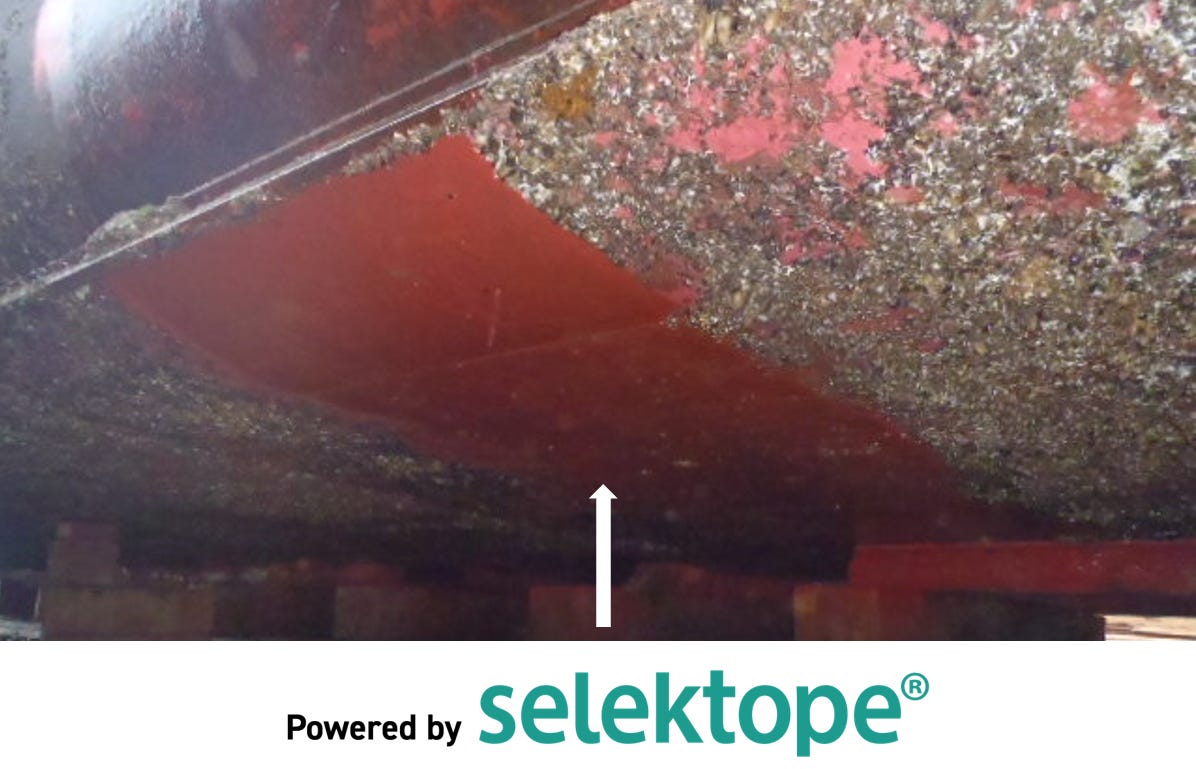
I-Tech sells Selektope to nearly all the big marine coatings makers, who then resell the paint that contains it. And once Selektope is in a formula, there's no getting it out.
Selektope is on just about 3,000 ships, out of a global fleet of roughly 100,000 (a TAM clearly inflated by management, but the point stands: the room to grow is enormous).
A hull keeps its paint for about 5 years before the next drydocking (yes, that's recurring revenue). Selektope has been through only about two cycles so far. In an ultra-conservative industry, allergic to the slightest change, two successful cycles start to build a track record that can win over even the most reluctant buyers.
Almost all of its revenue comes from Asia, where the paint makers and the shipyards are. Barely 2% from Europe, and yet Europe is the source of I-Tech's biggest problem: regulation.
In late 2025, the European Commission proposed not to renew the approval of medetomidine (Selektope’s active ingredient), suspected of being an endocrine disruptor (which I-Tech disputes). The stock is down about 50% from its peak.
If the EU doesn't renew the approval, two major consequences:
European approval often carries weight beyond the EU. If Europe says no, other regulators could be tempted to follow.
Without approval, Selektope could no longer be placed on the EU market, and a ship carrying it would become a headache to sell to a European owner or re-flag in the EU. And ships travel: over 25 to 30 years, they change hands and flags more than once. So it's a huge incentive for every paint maker not to offer Selektope to a client whose ships might one day end up European. And that "might" matters. Even if Europe isn't in the plan, the "just in case" often wins the owner over, and it costs the coatings maker almost nothing to sell a different paint instead.
Approval = thesis largely intact. No approval = a serious setback for the business model and its future. In between, a whole spectrum of outcomes (conditional approval, limited duration, and so on), each with different consequences for I-Tech. For now, the business is holding up.
The company is refocusing on R&D to diversify. But that’s too many “ifs” to build a thesis on today.
The final decision was expected around mid-2026, after a member-state vote in the first half of the year. But the approval has just been extended to 31 December 2026, because the assessment couldn’t be finalized in time. In the meeting minutes, some heavyweight member states come out flatly opposed. That said, this latest extension may be a sign that consensus is hard to reach, and that “no” is less of a foregone conclusion than it looks. What’s almost certain: if approval comes, it will be time-limited (say, 4 to 8 years) and conditional.
Trigger: a non-approval is a dealbreaker for me, and right now it's the most likely scenario. If approval comes, I still need to see the duration and the conditions. The only certainty today is that we’re dealing with a capable management team and an exceptional product, with the makings of a niche compounder that could grow into a very nice mid cap. If the EU is willing, of course.
Got something out of this? Do one thing: hit like and forward it to one investor who'd want to read it. That's how the undiscovered get discovered.
A Toy Store With a Moat That Beat Nvidia
Build-A-Bear; Ticker: BBW.NYSE; Price: $37.21; Market Cap: $468M; Distance from ATH: -50%; Country: USA.
Originally, Build-A-Bear sold build-your-own stuffed animals through a ceremony that mimics a birth. After serious trouble tied to a very asset-heavy balance sheet and a former CEO’s strategy that had grown ill-suited to the market, Build-A-Bear pulled off one of the most value-creating moves there is: going from asset-heavy to asset-light. From the COVID bottom to its late-2025 ATH, the stock did a 75x in five years, outperforming Nvidia itself.
I owned Build-A-Bear myself for a good part of that run, and it’s my biggest gain to date. I’ve been out of the stock for over a year, and that could change soon.
To understand Build-A-Bear, look at its moat: it sells an experience. You come in either to build your own bear or to immerse yourself in a world, that’s the reason 80% of store visits are planned.
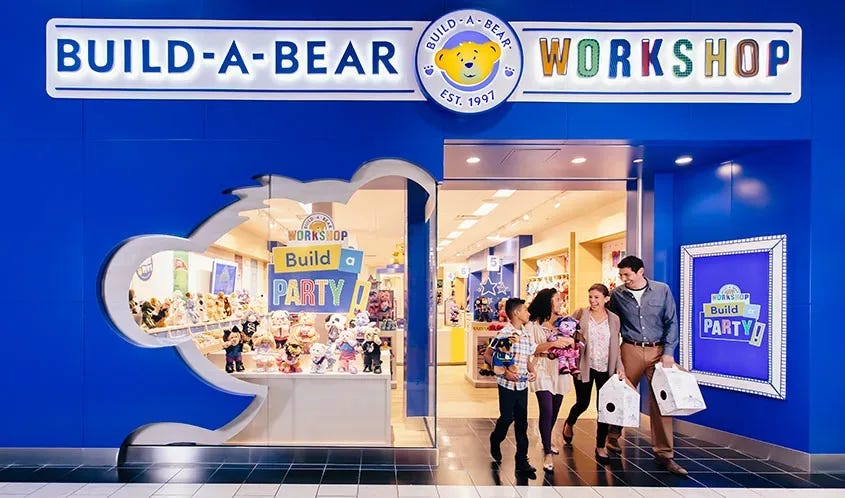
This moat comes with three big advantages.
First, when mall traffic collapses, an impulse store dies with it, while a destination store like Build-A-Bear holds up far better. During the FY 2024-2025 period, BBW’s traffic was down less than 1% versus 5% for a national benchmark. Of course, mall owners know it and actively seek out a Build-A-Bear for their mall, which obviously gets BBW ideal lease terms.
Second, the moat strengthens itself. The thirty-somethings who built their bear twenty years ago now bring their own kids, and buy one for themselves. This Kidult segment has taken off and now accounts for 40% of revenue. Good luck to the competitor who wants to rebuild thirty years of memories.
Finally, what retail customers love, companies want. That moat has opened partner-operated locations and franchises on nearly every continent (38 countries vs. 19 two years ago). CapEx is limited, margins are far higher, and it has been the growth engine of the past few years. The same argument works for the wholesale segment, where Build-A-Bear sells its products in more than 1,500 Walmarts with double-digit growth.
Financially, the balance sheet is clean. The company generated around $40M of free cash flow last year and used part of it to deliver an 8% shareholder yield. It learned from past mistakes and conflicts with former shareholders, and has bought back 25% of its shares since 2019. It's safe to call it shareholder-friendly. My only gripe: I'd like to see it ease off the buybacks when the stock runs hot.
Two reasons explain this -50%:
Tariffs cost $4M in 2025, with $10M guided for 2026.
US consumer confidence (the bulk of revenue) is at rock bottom. During Q1-26, domestic traffic fell 7% and e-commerce demand fell 26%. Almost every retailer has been punished over the past few months.
On tariffs, management has offset part of it with selective price increases. The macro backdrop limits how far that lever can go for now, so those increases haven't fully covered the tariffs.
On the consumer, I think the market overestimates the impact for Build-A-Bear:
Build-A-Bear's customer base is more economically stable and diverse than the average retailer's. So even with traffic down 7%, a higher dollar per transaction held net retail sales to around -5%.
The e-commerce drop mostly comes down to Google's AI search problems. It's a known issue, and management has hired and lined up partnerships to fix it.
The capital-light features (franchise, royalties, and so on) offset the weakness in direct-to-consumer. That's why it printed a solid Q1-26 despite all the domestic headwinds (still down 2% versus the record Q1-25, but holding). Very few of its publicly traded competitors can say the same.
It's not all rosy right now, and the company is guiding for continued DTC pressure through the rest of the year. But even after cutting its guidance for the year, it's still aiming for its best year ever in terms of revenue.
We’re potentially looking at a cyclical trough, offering a nice buying opportunity for a company that holds every card to weather a longer-than-expected cycle and to thrive for years.
Trigger: the business model has grown more complex in moving from asset-heavy to asset-light. It's now harder to forecast where Build-A-Bear will be in five years with these new variables. So I have to be more demanding on the margin of safety, and I'd only start a position below $30.
That's two of the five, and you already have the exact trigger on each.
The other three are the ones I rate highest:
An exceptional company, and my way to play the biggest sector conviction I hold for the coming decade.
A monopoly compounding in plain sight for years, run by one of the best management teams I've ever seen.
A Japanese compounder that created its own sector, now at the cheapest multiple in its history while it prints record quarter after record quarter.
Each gets the same treatment as the first two: why it survived the filter, and the precise price or event I'm waiting for before I buy.
All of it is for paid subscribers. Going paid also opens the full archive, including the post I think holds the most alpha of anything I've written.
One name at the right price covers years of this.
Now the best of the batch.