
SALT & VUL update: the 50% tariff, the no-bid winter, and the nervous money
The North American deicing salt market changed in six weeks.

A lot of news these past few weeks on the North American deicing rock salt market. Above all, a lot of news that slipped through the cracks, or got misread, and it bears directly on Atlas Salt and Vulcan Minerals. So it’s time for an update.
Today: bids going badly, a 50% US tariff on Canadian rock salt, and a look at private credit. Taken together, all of it directly impacts my scenarios for Atlas Salt and Vulcan Minerals.
Let’s get into it. (Whatever affects Atlas Salt affects Vulcan Minerals the same way.)
0. Table of Contents
A deicing rock salt market already tight in summer
The strain
Whose fault is it?
What this changes for Atlas Salt
The causes behind the causes
The tariff
What’s happening?
This time is really different
Salt gets drowned out
What this does to an already tight market
If it holds, what it costs Atlas
The lender mindset
Private credit and rocks
Private credit and tariffs
Disclosure
1. A deicing rock salt market already tight in summer
Winter hasn’t even started, and it’s already got a good shot at making history.
1.1 The strain
First stop: Illinois. The beautiful little town of Itasca will pay $74.33/t for deicing rock salt, versus $70.79 last year. A 5.0% increase. Mount Prospect, about a 20-minute drive north, will pay $112.59/t versus $68.35 last year. A 64.7% increase. Surprising, isn’t it? Yet it’s the same salt being sold, and the few miles separating the two towns don’t explain that kind of price swing. So what’s going on?
Itasca didn't have to go out to bid this year, it simply exercised a renewal option on an existing contract. That contract caps the increase at 5%, and the producer squeezed it to the fourth decimal (5.0007%, to be exact). Mount Prospect, by contrast, had to buy on the open market, where supply and demand set the rules without friction. The +5% is just a legal artifact, while the +64.7% is a signal: winter is going to be brutal for DOTs, municipalities, and counties alike.
1.2 Whose fault is it?
A quick refresher on how the sector works. A public buyer puts its salt contract out to bid in spring/summer to prepare for a winter that starts in October/November. The buyer commits to a minimum tonnage (60% to 80% of the stated quantity), while the supplier commits to delivering a bit more if needed (110% to 140%). Prices are also boxed into a narrow range that depends mostly on the volumes purchased. Beyond that, it’s the hard law of the open market.
To sum up, it’s a reverse-auction system. The system only produces a low price if several sellers are competing for the buyer. Conversely, if a producer already has an outlet for its volumes (less production, or more demand), this system does nothing for it. Why lock in its price for a year, while being on the hook to deliver salt to dozens of scattered sites, when it could ride a price increase instead (or one it sees coming)? Nothing legally forces it to.
Right on cue: this year, several major producers decided not to take part.
Now to New York State. The state’s road salt contract runs around $240M a year. So, a big contract. Yet Compass Minerals (one of the largest salt producers in North America) officially announced it wouldn’t take part in the bid, a contract it had actually bid on just last year. Compass Minerals’ CEO laid out the strategy on the latest earnings call: “Really try to serve those markets who we maximize our margin with and not trying to serve everything everywhere.”
Back to Illinois (yes, we’re spending a lot of time on the road). 250+ municipalities got zero bids through the state’s buying pool. Not one. The agency running the bid explained that the major supplier that normally serves the state chose not to participate. Worse, it promised no emergency fix, and said that if it found one, it would likely come at a steep cost. Its advice to municipalities: find salt on your own. In Ohio, 18 counties got no bids in the first round. The state DOT was forced to reopen the entire bidding process.
Roads can’t stay covered in snow. So towns and counties are paying the price, when they can:
Jefferson County (Ohio): bid price of $155/t (+134% YoY).
Salem (Ohio): bid price of $151/t (+156% YoY). Salem turned it down and managed to bring in salt from Kansas for $115 and had to cut its order by a fifth for lack of budget. Trucking it in over 1,000 km became worth it because the local price had gone up 2.6x.
Naperville (Illinois): announced “$113.50 at minimum, and over $140.”
Three-digit prices per ton, three-digit swings too. It makes good headlines. That's not the part that interests me most. What made me crack a smile is the 5%.
1.3 What this changes for Atlas Salt
Based on the few figures published so far, the low end runs around 4-5% a year on average. Last year, Massachusetts and Pennsylvania saw their average price rise 4.5%. So even in the (near-)coastal markets supplied directly by ship, where the salt market should tilt most in the buyer’s favor, the low end sits above the UFS salt price estimate (the study that assumes 4% annual price escalation through 2030 and 2% for the two decades after). I’ll say it again, that’s the low end. The average price will mathematically come in above that. Compass said: “In our core U.S. markets, we're seeing substantial price improvement year-over-year, in some cases, well into the double digits with consistent growth in demand tenders. [...] It would be safe to say that overall, we're around double digits in price increase”.
That’s a long way from the 5% in my bull case, or the 4%/2% from UFS. The price of salt, though, is by far the single most important variable for Atlas Salt’s value. And for two seasons running, the smallest increases have been nearly in line with my own bull case. We’re seeing more and more 100%+ increases, and winter hasn’t even started yet. That’s the kind of news a future North American rock salt producer likes to read. But in the end, will it actually affect Atlas Salt? Won’t all of this settle down before Atlas Salt starts producing?
First, the cost question. Last quarter, Compass Minerals saw revenue in its salt segment rise 5%, against EBIT down 25% and adjusted EBITDA down 15%. It’s tempting to conclude that the price increase didn’t offset the cost increase, and that this is bearish for producers. But if investing were just a matter of numbers, accountants would be the best investors in the world. Except I don't know any extremely rich accountants, so let’s dig in a bit.
First subtlety: timing. The quarter ended in late June. So this quarter is mostly invoices for tons delivered under contracts signed in 2025, with the limited price increases that came with them. Their “around double digits” comment is from August 6 and covers winter 2026-27, so it won’t show up in their books until this fall.
Next, the direct causes:
Deicing volumes dropped 6%, which mathematically pushed up the cost per ton (most of the costs are fixed). Why the drop? They produced more tons, but at higher cost. And since the market “was really tight,” they took the opportunity to “serve those markets who we maximize our margin with and not trying to serve everything everywhere.” To sum up, they produced more salt but sold more of it outside the deicing market. Why the higher costs? Because of how old the mines are. Salt is extracted around a shaft. After 60 years, the salt near the shaft has already been mined out, and every new ton has to travel a longer stretch underground before it sees daylight, so crews and machines have to travel farther. Compass wants to reduce that impact, and that’s the second cause.
Compass deliberately invested in its two American mines (drifts and infrastructure) to cut future extraction times for tons of salt (and therefore costs). So it sacrificed today’s margin to boost future margins.
The rise in fuel prices and trucking freight, one of Compass’s main distribution channels, since it owns the entire distribution chain (from the bottom of the mine to the municipality’s salt dome).
Out of 3 causes, that’s 1 that hits every producer, but especially those that depend on trucking, and 2 that are specific to one of the continent’s major producers, one that’s forced to control its production and invest, and is paying the price for it now in its margins. It tells you as much about Compass’s health as it does about supply overall (a large share of mines are old and getting harder to operate).
Of these 3 causes, Atlas will only be affected by the rise in fuel costs. In a limited way though, since the vast majority of Atlas’s tons will travel by ship.
OK, Atlas will structurally dodge a good chunk of the current cost increases, but will it benefit from today’s price increases down the line?
Nothing beats an official chart to answer that, in this case, the rock salt producer price index. Over forty years, the index has compounded at 4% a year versus 2.8% for inflation, and the largest cumulative drawdown never exceeded 10%. The rare significant price declines are the ones that follow a sharp price increase. The overall trend is that price increases tend to stick in the following years. The price ratchets up and stays there.
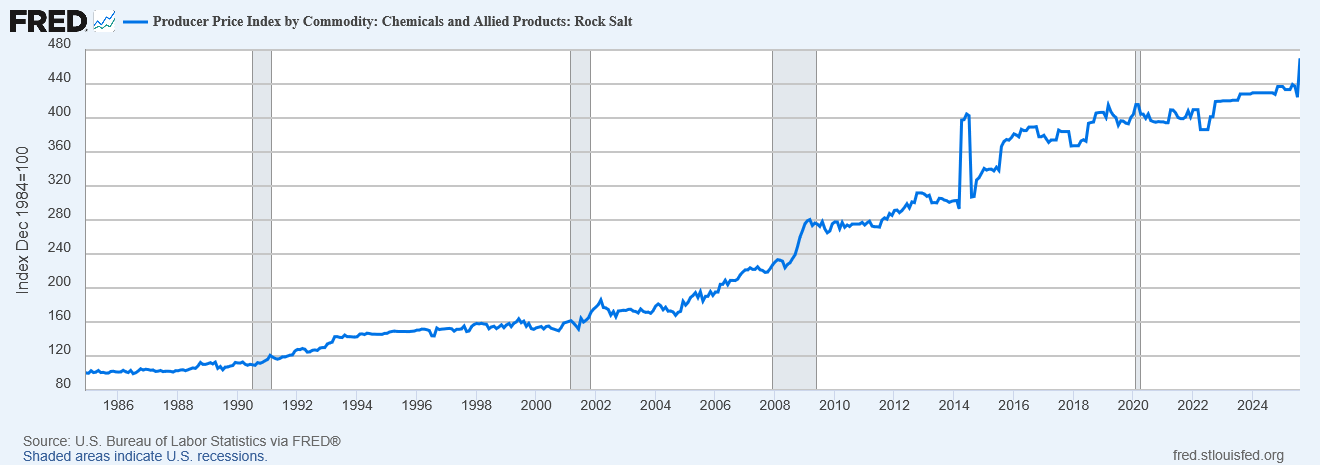
To sum up, the recent price increase is largely tied to factors Atlas Salt won’t be exposed to, but the price increases that come with them tend to stick, and that will benefit Atlas, both for its financing (a lender lends more easily when it sees future cash flows naturally rising ahead of production) and for its future output.
Every year that prices rise for reasons intrinsic to producers is a windfall for Atlas Salt.
1.4 The causes behind the causes
In a market as old and mature as rock salt, it’s always worth stepping back and asking “Why?” one more time.
Two brutal winters back to back drained a good chunk of inventories, and prices are rising. Sure, but there have always been brutal winters. So why?
Nobody wants to stockpile salt. Let’s go back to the New York State contract. Salt storage there is billed at up to $8/ton/month after December. Blame it on salt that’s heavy and cheap, with a convenient tendency not to spoil. In the end, it’s in everyone’s interest to let the neighbor store the salt. You can read it straight off the contract structure itself: a minimum stock guaranteed by the buyer, and a certain overage guaranteed by the seller (in exchange for an extra price bump). They were designed to minimize the storage cost for every link in the chain. It’s simple: a month of storage can potentially cost more than a +5% price increase on a contract. Every player is simply acting in a way that’s consistent with the constraints and incentives the market structure imposes.
And it works, as long as some mine somewhere has spare capacity to absorb winter’s whims and bad human forecasting. That capacity is the market’s real inventory. And it’s been disappearing for years. A quick recap is in order.
North American supply has stopped responding:
No new mine in 25 years.
Avery Island closed in 2021 for economic reasons. Either way, the mine was flooded in June 2022. That capacity is gone for good.
Cargill, which is walking away from certain assets and has been trying to sell these mines since 2023 without finding a buyer (both under a lake, with environmental liabilities almost no buyer wants to take on).
Compass Minerals, which says it can’t hoist as many tons as it wants at the cost it planned at Goderich, the largest underground salt mine in the world.
On the other side:
US consumption up 10% in a year, with flat production (2024-2025).
US reliance on imports went from 23% to 31% of apparent consumption over the same period.
Imported salt from outside North America that’s very distant and unreliable, both in quality and quantity, and that fills the demand created by this growing reliance about as well as it can. Reminder: Mexico is excluded from the analysis since it only serves the West Coast (I explain it all in my deep dive).
A supply chain stretched to the max that absorbs every shock with nothing to cushion it (production delays, rising fuel prices, etc.).
Take all of that, and you’ve got a market getting worked up before winter even arrives.
As a result, Great Atlantic Salt’s economics keep improving without management having to spend a single dollar. And winter hasn’t even started. What’s this going to look like if it’s a brutal winter?
And into that already-stretched market, Washington just dropped a 50% tariff on Canadian salt.
2. The tariff
The rest is for paid subscribers only.
I won’t try to convince you. That would waste both of our time. I know for a fact: the people who go paid do it for the quality of the work. So I’ll let the work do its own marketing. Suit yourself.