
ISSC Acquires Aydin Displays for $24.5M: My Full Breakdown
Little was disclosed. So I dug through 13 years of filings to figure out what they actually paid for.

Finally, some news. Innovative Aerosystems (ISSC) has just acquired Aydin Displays, its seventh acquisition in three years (four months after the last one).
On July 21, ISSC bought Aydin Displays, a maker of ruggedized displays for military applications, for $24.5M. ISSC guided Aydin’s revenue to $16M for 2026.
Yes. ISSC really did buy the manufacturer itself, with everything that comes with it: engineers, plants, patents, and so on. This is a different animal from the handful of product lines or licenses ISSC has folded into Exton before.
We’re talking about a 40,000 sq ft plant in Birdsboro (about 45 minutes by car from the Exton plant), around fifty employees, production lines, equipment, and an entity with its own P&L and its own balance sheet. One catch: the margins weren't disclosed. Not for now, anyway. It’s possible ISSC never publishes them.
All of this points to one thing: to understand and judge this acquisition, you have to forget the paradigm inherited from the six previous ones.
Understanding this acquisition and its implications first requires knowing ISSC and its subtleties well. I’ll assume you do (just in case: here’s my full deep dive on the company).
I dug through the SEC archives to arm myself with everything I need.
First, what they bought, in detail.
Table of Contents
What ISSC Bought: Aydin Displays in Detail
Aydin Displays’ 13-Year Ownership History
Why ISSC Acquired Aydin Displays
The Obvious Play
The Less Obvious Play
Valuing Aydin Displays Without Published Margins
How ISSC Financed the $24.5M Acquisition
Aydin Displays’ Market Position
Verdict
1. What ISSC Bought: Aydin Displays in Detail
Aydin makes ruggedized displays that have to survive where other displays have gotten used to dying. On the deck of a destroyer, for example, deep inside a submarine, or embedded in an armored vehicle. The company supports "over 20 military platforms across more than 80 countries out of its vertically integrated manufacturing facility."
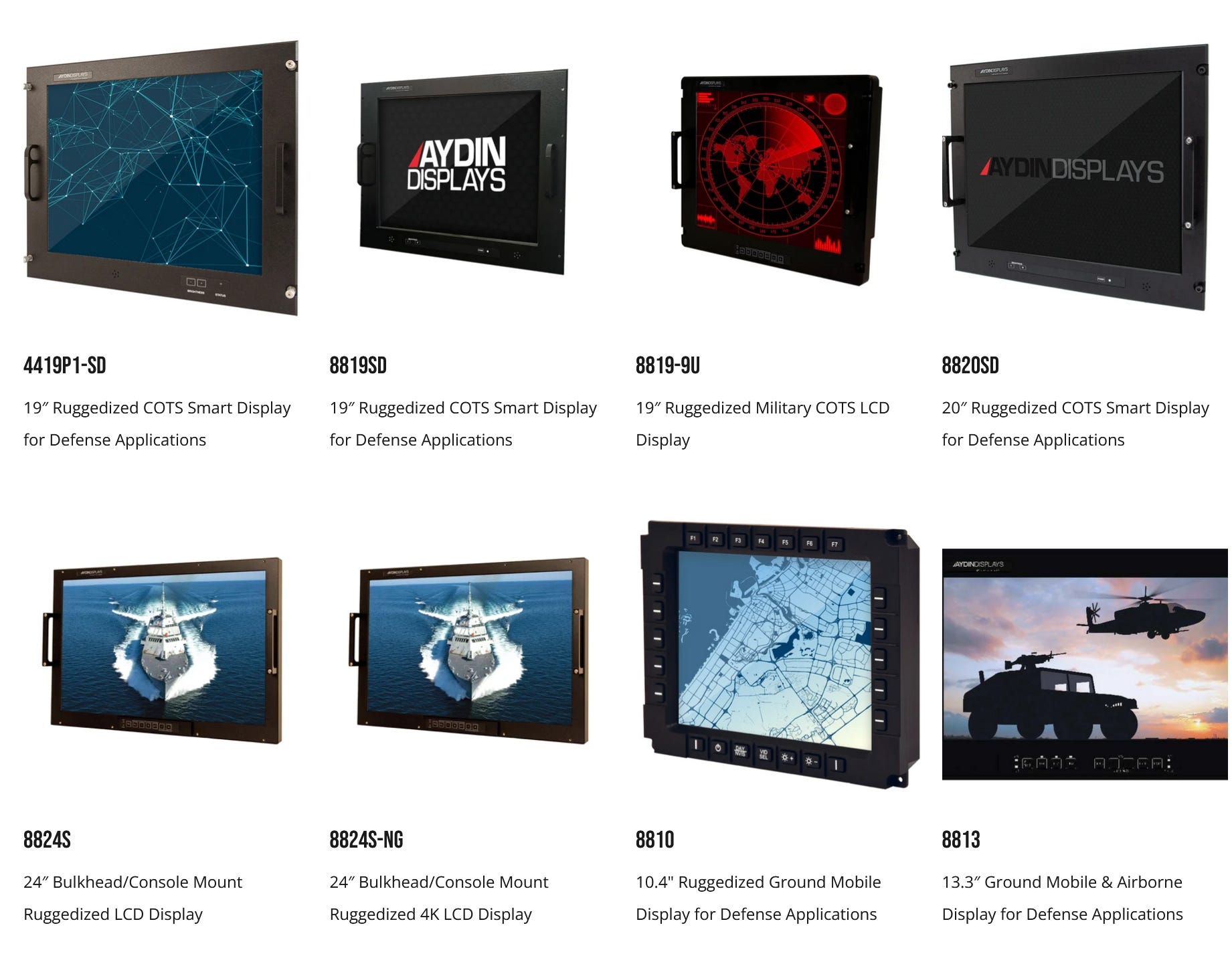
Their products range from 10 to 65 inches, are AS9100D certified (the quality standard for aerospace and defense), and have been sold to the US Navy and its prime contractors for 50+ years. Those contractors (BAE, Lockheed, etc.) account for the bulk of their defense sales. Direct purchases by the Navy are mostly limited to buying a few spare parts.
Fine, at first glance you can file this under the defense-focus strategy Askarpour put in place when he arrived in 2022, and hope it creates as much value as the F-16 lines. But here ISSC is playing a new game.
In its previous acquisitions, ISSC bought selected assets, left the rest to the seller, and obtained its own TSOs to get the regulatory right to run those lines (product by product). That took about a year, with some inefficiencies and a bit of lumpiness in revenue in the meantime.
Here ISSC bought the whole company for $24.5M. Of course that includes the engineers, the lines, the patents, and so on, but also, and above all, its CAGE code (the company’s identifier with the government and defense customers), its customer contracts, and its certifications and qualifications. All the assets, but also all the liabilities, which for now are unknown to us.
The $24.5M was funded by a draw on the JPMorgan facility, on a cash-free/debt-free basis and adjustable on working capital within 90 days (the impact should be minimal). No escrow, no holdback, everything is paid at closing, and any bad surprise ISSC discovers will be settled through a claim directly against the seller. So it’s either proof of confidence in what’s inside the box, or proof of confidence in the seller’s solvency, or, very probably, both.
The seller is Sparton Corporation, an Elbit Systems of America entity, itself a unit of Elbit Systems, an Israeli defense company. We’ll come back to it, because the seller’s origin is itself a source of potential synergy, and therefore of value creation.
To quickly sum up the rest:
Elbit signed a Supply Agreement and therefore remains a customer of Aydin (terms not published),
Elbit signed a five-year non-compete clause for the United States and Canada (Aydin sells its displays to Royal Canadian Navy frigates),
a TSA (Transition Services Agreement) under which Elbit commits to providing Aydin with its usual support services for the length of the transition (ERP, accounting, and so on, which ISSC will therefore have to absorb).
All of it signed and closed on July 21, with an extension of the Birdsboro lease. So Aydin’s plant stays, at least for a while.
2. Aydin Displays’ 13-Year Ownership History
Usually I’d have gone for irony before disappointing you, but no irony this time: ISSC didn’t give us Aydin’s margins. No P&L, no EBITDA, in short, nothing that lets us properly judge the multiple paid for this acquisition.
But you're not here for descriptive work, so I dug a bit. My starting point: Aydin wasn’t born on July 21, 2026 (a very original thought, all things considered). It has already been sold, several times, by owners who were themselves listed. Their official filings therefore give us Aydin’s old numbers (among other things). Let’s go back in time.
2013, to be precise. Aydin belonged to Video Display Corporation, a fading American display maker that put it up for sale. The pro forma accounts filed in connection with the sale give us a precise but old snapshot of the company: that year, Aydin did $17.6M in revenue (yes, against $16M guided for 2026), and at an operating loss on top of it.
Sparton (a defense electronics contract manufacturer) bought it for $15.5M, i.e. 0.88x sales for a company losing money. The vehicle Sparton set up for the deal was called Sparton Aydin, LLC. The same entity ISSC just bought 13 years later. Okay, but what about the Sparton era?
One clue: the contract provided for an additional $6.6M earnout (an extra amount paid to the seller only if Aydin hit a target EBITDA within 12 months). I dug through the filings on both sides, and I found nothing anywhere. So the EBITDA threshold very probably wasn’t hit (”absence of evidence is not evidence of absence” saves them).
It probably started badly, but it definitely continued badly.
The ruggedized display backlog fell from $14M to $9M in just six months in 2016. Meanwhile, Sparton made acquisitions to grow Aydin: IED in 2014 and KEP Marine in 2015, for a total of $7.6M. To sum up: what little growth there was got bought, or rather rented. At a steep price. Let’s do a bit of arithmetic. Aydin alone in 2013: $17.6M in revenue. 13 years, two acquisitions and $7.6M later, revenue is guided to $16M. In nominal terms, it’s very ugly. And that's before adjusting for inflation. Before anyone nitpicks: this is still defense, margins can’t save the situation.
So ISSC is buying the company after four successive owners, none of whom managed to grow it, and it’s doing so at 1.5x 2026 revenue. Hence the importance of the margins we don’t have. It’s possible ISSC gives us more information in the 8-K/A that should come out in the next 90 days. Possible, not certain. So we have to judge without it.
Historically, the acquisition can look expensive, but ISSC is an unusual buyer with the ability to unlock forms of value that are out of reach or trivial for other owners.
3. Why ISSC Acquired Aydin Displays
3.1 The Obvious Play
ISSC is different, but the previous buyers had their own particularities too.
Video Display Corporation was in its death throes. Aydin was a way to scrape together some life-saving cash, even at the cost of dumping the business. The simple fact that the company itself was losing money is very telling. A good business in the hands of a bad manager will very often become a bad business.
When Sparton bought it, it immediately had more important things to deal with: a takeover attempt by Britain’s Ultra Electronics (blocked by the US Justice Department in 2018, so years later). After the failed takeover, Sparton was taken private by Cerberus in 2019, while divesting its contract manufacturing division on the side. Aydin and its $15M of revenue at the time were almost a rounding error for a company fighting for its survival.
Now, Cerberus is private equity. The goal is to sell fast at a profit. So it sold Sparton to Elbit two years later for $380M. Aydin was more of a throw-in than a bonus. Elbit already made some of its own military displays, so we can safely say Aydin was anything but their priority.
In 13 years, nobody had the strategic reason or the means to grow Aydin (we’ll come back to why in detail later).
ISSC is the first owner for whom the company and its products matter. Displays are one of the six cockpit building blocks it already assembles. What counts in the Aydin purchase are the assets ISSC was missing.
Here are, in my view, the three things ISSC got out of this acquisition. Two out of three follow the same process as the previous acquisitions:
Access to a new market segment, in this case naval and land. Before this acquisition, ISSC sold exclusively cockpit parts for aircraft. Aydin is an open door to the decks of ships and the turrets of armored vehicles, to their respective primes, their programs and their replacement cycles (aftermarket, what a lovely word). But there’s more... let’s wait for point 3.
Good engineers. Management had already mentioned the difficulty of finding good engineers. They bought the plant 45 minutes away by car, around 50 employees, engineers included. Clever. And they’re proud of it: “bringing us exceptional engineering talent, proven display technologies, and a respected product portfolio that aligns closely with our expanding family of aerospace solutions.” The CEO mentions the engineers first. In a way it resembles ISSC’s strategy, buying certified production capacity rather than building it yourself, but with the plant and the people already trained.
And finally, the eternal cross-selling (a lovely word too). Aydin’s displays go into ISSC’s cockpit and mission solutions, and ISSC’s catalogue gains an entry point with Aydin’s naval customers and primes. In a sector this locked up, excellent salespeople would never have made that happen, even if paid $24.5M for the job. At first glance, the current cross-selling opportunities look relatively small compared to other acquisitions, but in a longer-term defense-focus strategy, future acquisitions will potentially (probably) improve and round out those cross-selling opportunities in land and naval.
Nothing revolutionary at first glance, it follows ISSC’s strategy completely, with the engineers on top. But that’s not all. That was the obvious part, but I strongly suspect ISSC has other “assets” in its sights, the kind you’ll never find on a balance sheet.
3.2 The Less Obvious Play
The rest is for paid subscribers.
You get 1 free article. If this one got under your skin, help yourself.
But future ISSC updates will be locked, along with every other company I cover or will cover.
For those interested: I publish 20+ deep dives like this a year, with regular follow-ups, up-to-date valuation models, and a lot more. I'll leave it at that, my content is my best pitch. Go have a look.
