
ISSC Q3-26 + eVTOL Contract + What Comes Next
A $50M contract, a customer whose order book is 83% non-binding, and a pro forma table that doesn't add up.

Innovative Aerosystems (still ISSC on your screen until August 18, IA after that) reported Q3-26 on August 13.
A quarter, an earnings call, and a new contract. That’s a lot to get through, so let’s not waste time.
I’m assuming you’ve read my deep dive and my analysis of ISSC’s latest acquisition (Aydin). If not, here they are.
The quarter first, then the contract, then the future. Let's go.
0. Table of Contents
The Quarter
The right comparison
Tracing the organic growth back to its source
The margin picture
Gross margin and mix
Operating margin vs EBITDA margin
A misleading EPS
Orders and book-to-bill
An error in the 10-Q
The eVTOL Contract
The facts
What $50M really means
Who’s on the other side
The certification path
The inconsistencies
Why it matters anyway
The Future
Updating the inputs
The IA Next 2029 arithmetic
Revising the thesis
Wrap-up and Disclosure
1. The Quarter
The numbers (Q3-26 vs Q3-25):
Revenue: $26.7M vs $24.1M (+10.7%)
Gross margin: 51.7% vs 35.6% (+16 pts)
Operating margin: 22.6% vs 14.6% (+8 pts)
Adjusted EBITDA: $7.7M vs $4.4M (+74.7%)
Diluted EPS: $0.246 vs $0.137 (+79%)
Backlog: $82.9M vs $72.4M (+14.5%)
Same story as always with ISSC: comparing properly means adjusting first.
1.1 The right comparison
What we’re after is organic growth.
Now, in Q3-25 the company was insourcing production of the F-16 flight control computers it had bought from Honeywell. The problem: demand didn’t stop during the transition. So Honeywell built them in bulk up front, fast, and took the opportunity to charge ISSC a steep price for them. A very steep one. The result: $12.6M of F-16 revenue recognized at completely depressed margins, cut to the bone by Honeywell.
F-16 revenue this quarter was $5.7M at normalized margins, which the CEO sees as a sustainable run rate. Cherry on top, that normalization cuts the Lockheed dependency in one go: over nine months, Lockheed went from 47% to 20%. One less thorn in its side.
We have what we need to adjust, so let’s adjust and strip F-16 revenue out of both quarters:
Q3-25: $24.1M - $12.6M = $11.5M
Q3-26: $26.7M - $5.7M = $21.0M
An 82.6% increase.
+82% organic growth?! Obviously not. “For the nine months ended June 30, 2026, there were $2.3 million of Net sales attributable to the acquired businesses.” The period contains acquisition Wave 3: Moog in February and the two Honeywell lines at the end of March. It’s easy enough to assume that (almost) all of the Honeywell lines’ revenue lands in Q3-26 (April-June). For Moog, the same assumption is less straightforward. Let’s make it anyway. First because Moog’s revenue is very probably a minimal slice of that $2.3M, and second because management says so: “since the acquisition date of the transactions, there were insignificant amounts of revenues and net income related to the acquired businesses.” (10-Q, Q2-26).
So $2.3M of acquired revenue in Q3. Adjust for it and organic growth comes to 62%.
62% organic growth is still enormous. The problem is that the CFO himself put organic growth “over 40%” for the quarter. The gap, I think, comes down to what the CFO calls “F-16 revenue.” F-16 revenue is made up of products and services. I stripped out both. Let’s try stripping out only the products.
That means adding F-16 service revenue back into the calculation above. Problem: we don’t have the absolute figures, only the change. Services fell by $1M. And that delta alone isn’t enough to pin down the CFO’s number precisely. So let’s take two extreme cases:
F-16 service revenue = 0 in Q3-26.
Q3-25 → $24.1M - $12.6M + $1M (the service revenue delta) = $12.5M
Q3-26 → $26.7M - $5.7M - $2.3M (the acquired revenue) + 0 = $18.7M
18.7 vs 12.5 → +49%
F-16 service revenue in Q3-26 = 50% of F-16 revenue.
Q3-25 → $24.1M - $12.6M + $3.9M = $15.4M
Q3-26 → $26.7M - $5.7M − $2.3M + $2.9M = $21.6M
21.6 vs 15.4 → +40%
(Note that in both cases, the subtraction gives $6.2M: 18.7 − 12.5 = 21.6 − 15.4 = 6.2. This $6.2M is the YoY organic growth delta for the quarter.)
Even at two opposite extremes, organic growth lands in a range that fits what the CFO said. Conclusion: he almost certainly left F-16 service revenue in the base for his organic growth calculation, which is what pulls the number down so sharply.
Overall, the trend is clear: organic growth is very significant. So let’s look at what’s hiding behind the word.
1.2 Tracing the organic growth back to its source
Using management’s method for computing organic growth, you land on $6.2M from Q3-25 to Q3-26. We may not have the exact amounts, but we do have the changes from Q3-25 to Q3-26.
Commercial aftermarket (products) +$4.0M. Nothing new here: ISSC is simply riding the aging of the global fleet (the aftermarket “megatrend,” a reason that almost makes the case for the segment on its own, in my humble opinion) and the Airbus and Boeing production delays caused by their supply chain issues (a “narrower” cause). It’s still revenue ISSC created: “products that we had developed that were certified roughly last year, that are beginning to take some grounds [sic] here like the EICAS system for the 757/67. We’ve developed LPV for the 757/67 as well as some software upgrades to update the magnetic variations... new products that we’ve developed over the last couple of years.” (Conf Call, Q1-26). In short, revenue largely created in-house by ISSC adapting to its market (part of the acquired IRU and radio lines also lands here).
Business aviation +$2.1M. A good chunk of that is attributable to the UMS-2, the AI-boosted version of the UMS for the Pilatus PC-24, and to an easy comp (less revenue while the market waited for the UMS-2). One subtlety: production only started in June, so a third of the quarter. Again, revenue created in-house by ISSC.
Non-F-16 services +$2.3M. That’s $1.3M of repairs on products from the acquired lines, $0.8M of customer-funded engineering and $0.2M of legacy customer service. None of it is very informative.
Add non-F-16 military (products) at +$1.0M (derived), on which no useful detail is given. Then add the −$1M of F-16 services and the −$2.3M of acquisitions, both mentioned earlier, and you land on $6.1M (the gap with my $6.2M from the previous subsection is just rounding).
And there it is. What I consider one of the best pieces of news of the quarter, if not the best. Why?
A good part of ISSC’s “organic” growth is purely organic: products created inside customer relationships that have run for decades, with an ingrained understanding of the company’s market, with engineers able to design, develop and produce, and to create value.
This quarter puts more weight on the aftermarket. That capacity to innovate counts, but here it’s peripheral (though its impact isn’t trivial). The tailwind carrying the aftermarket carries every company exposed to it, and therefore every one of ISSC’s competitors in that segment.
What interests me most is the UMS-2.
It’s a product ISSC’s engineers developed over years and built start to finish, at Pilatus’s request (and partly with Pilatus’s money). In-house innovation producing growth that is entirely organic, as opposed to acquired revenue that gets reclassified as organic the following fiscal year.
More concretely, I see 4 reasons why the UMS-2’s success is excellent news:
The UMS-2 will contribute significantly to revenue, and therefore to the IA Next 2029 target (forget multiplying by 12 to size it, the real figure is probably well below that, but still significant). Which means less M&A needed, with everything that implies for the balance sheet.
ISSC can still build its own aftermarket annuities, which means having a direct hand in its performance over the coming decades instead of depending on M&A alone (for a long-term investor, that counts).
ISSC can still innovate meaningfully nearly 10 years after the Autothrottle, and the UMS-2 raises the odds on the Liberty Flight Deck (a purely Bayesian argument, and the recent LFD contract obviously weighs in here).
The UMS-2 is platform-agnostic (it isn’t tied to one aircraft). Two years ago, management was already saying: “we see significant growth potential for this product line over the next several years, particularly within the military and business aviation markets.” A significant military win on the UMS-2 would be worth as much for the incumbency it buys with military integrators as for the revenue: time on one program is what tends to earn you the right to bid on the next. Not counting the aftermarket annuity, obviously. Three birds, one stone.
All of this shows ISSC isn’t just a buyer of product lines and companies, optimizing and cross-selling an aging catalog. It’s a company that reads and understands its market, innovates accordingly, knows its product and service portfolio inside out, and knows which line to acquire to complete it.
We’ll come back to the impact of all this more than once.
1.3 The margin picture
1.3.1 Gross margin and mix
As we’ve seen, forget the YoY comparison. Look at the last three quarters instead: 54.5%, then 51.1%, then 51.7%. Above 50% every time, while management guides to a long-term gross margin of 45-50%.
The usual suspect is mix. Over the quarter1:
commercial aftermarket adds $4.0M,
business aviation $2.1M,
and military loses $4.9M.
We’ve seen it many times: military comes with higher COGS and lower SG&A and R&D spend. Less military = better gross margin. Just math. And management has been saying for years that it wants to shift further and further into military (and acting on it).
That said, since Q3-26, management has sounded more… optimistic: “Guidance we have given before was somewhere around 45%-50%. Again, quarter per quarter, depending upon the product mix that we sell, those margins are going to vary. But around 50% seems to be where we are heading. On some of these product lines that we acquired as well, the insourcing of the circuit cards is ongoing right now. And we believe that once all of that is completed, that those margins should become more uniform and as well as fall within that 50% gross margin, which is our ultimate goal, is to try to keep it there” (Conf Call, Q3-26).
Three things come out of all that:
Gross margin will stay lumpy, at the mercy of mix.
The more the revenue mix skews toward defense, the more gross margins decline (which is what I want as a shareholder).
Acquisitions will keep distorting gross margin for as long as they take to integrate (next quarter contains Aydin plus the two Honeywell lines).
While we’re here, let me quote management’s usual answer to the sempiternal margin question one more time: “So this is why we’ve been trying to steer everybody away from gross margins and put a focus on EBITDA margins and profit margins. I mean, quite frankly, I care about profit more than anything else.” (Conf Call, Q2-25).
Precisely.
1.3.2 Operating margin vs EBITDA margin
Same method: forget YoY, look at the series.
28.9%, then 22.1%, then 22.6%. Over three quarters, gross margin loses 2.8 points against 6.3 for operating margin.
Operating expenses gain 3.5 points over the period, SG&A 2.5 points. Even R&D adds 0.9 points. No surprise: integrating acquisitions and developing new products under contract are investments that cost before they pay. Management has been flagging them as investments for several quarters, and they’ve earned the benefit of the doubt.
Adjusted EBITDA margin came in at 28.8% for the quarter (30.8% over the last three quarters), so we’re comfortably inside the IA Next target of 25-30% (a reminder that ISSC doesn’t add back SBC in its adjusted EBITDA calculation; for reference, that’s worth 2.5 points in Q3-26).
What’s more “awkward” is the gap between adjusted EBITDA margin and operating margin. From 3.7 points a year ago to 6.3 today. The main culprit is obviously amortization: intangibles went from $23.6M to $46.0M in nine months. Almost 2x. That’s the cumulative weight of the acquisitions. And every acquisition pushes operating reality further from accounting “reality.”
That gap doesn’t stop operating leverage from working its magic: +71.5% operating income on 10.7% revenue growth. Not bad.
Next quarter promises to be an interesting one, accounting-wise.
1.4 A misleading EPS
$0.246 vs $0.137, +79%. The prettiest number in the table, and also the biggest liar.
Effective tax rate for the quarter: 10.5%. A year earlier: 21.5%. Over the first six months of the fiscal year: 27.3%. The 10-Q gives two reasons for the low rate: “temporary and permanent tax differences related to stock-based compensation and favorable return to provision adjustments.”
Translated:
On one side, the deductions tied to employee stock awards, which grow when the share price rockets between grant and exercise. For the less attentive among you, the stock went from $8 to $30 in five months (from $5 to $30 in a year). I think “rockets” covers it.
On the other, a return-to-provision adjustment after the actual return was filed. The detail doesn’t matter much here.
Normalize the quarter’s tax rate to 22% (the “usual” rate) and you get:
Net income: $3.9M instead of $4.5M;
EPS: $0.214 instead of $0.246;
Growth: +56% instead of +79%.
Still enormous, but a good chunk of it was bought. Almost no dilution to get that EPS (+2.4% in a year) and minimal debt: $0.056 of interest per diluted share this quarter, and it gets paid off fast. Accretive is an overused word. Here it fully earns its keep. (Forget adjusted EPS. EPS is an accounting construct by nature, it doesn’t reflect operating reality. Adjusting it makes no sense to me, even just to compare.)
1.5 Orders and book-to-bill
I’d like to say “non-issue, straight on to the next part.” But you don’t trust me. You trust arguments, and you’re right to. So here are my arguments.
Book-to-bill at 0.85, with a backlog down $4.1M over three months but still up $5.5M over the year (part of it potentially bought).
Why don’t we care? Two reasons:
ISSC sells in batches. One operator retrofitting its fleet, or one integrator placing an order on a production run, and the quarter makes it look like a completely different company. That lumpiness is intrinsic to the sector. It’s the very source of the mix swings that scramble the margin read on a quarterly basis.
It’s in every filing: the backlog explicitly excludes future sole-source production orders arising from development programs. Which makes backlog a fairly poor predictor of future revenue.
Worth a quick mention: Aydin will almost certainly scramble the book-to-bill further still. The eVTOL contract will have its say in 2027 too. More on that later.
1.6 An error in the 10-Q
Note 3 of the 10-Q. One of my favorites. Usually, anyway. Not this time.
Roughly, it says: here’s what the first three quarters of FY-25 vs FY-26 would look like if every acquisition had closed on October 1, 2024. In other words, it neutralizes the timing effect of the acquisitions across the compared periods by recalculating as if they had all been done before those periods.
The numbers, first three quarters of FY-26 vs first three quarters of FY-25:
Revenue: $71.01M vs $76.96M (−7.7%)
Net income: $10.30M vs $12.84M (−19.8%)
Those numbers are wrong, in my view. Here’s my reasoning.
The pro forma adds $0.1M to reported revenue. The Q2-26 10-Q added $6.06M over six months. And ISSC already owned its three lines through Q3-26. The incremental adjustment can only be zero or positive, so the nine-month adjustment can only be greater than or equal to the $6.06M of the Q2-26 pro forma. Instead, the gap drops to $0.1M in the Q3-26 report. And I think I’ve found their mistake.
The nine-month pro forma for Q3-25 equals the six-month pro forma from Q2-26 plus Q3-26 revenue. To the dollar. You’ll agree that computing 2025 pro formas from 2026 data makes no sense.
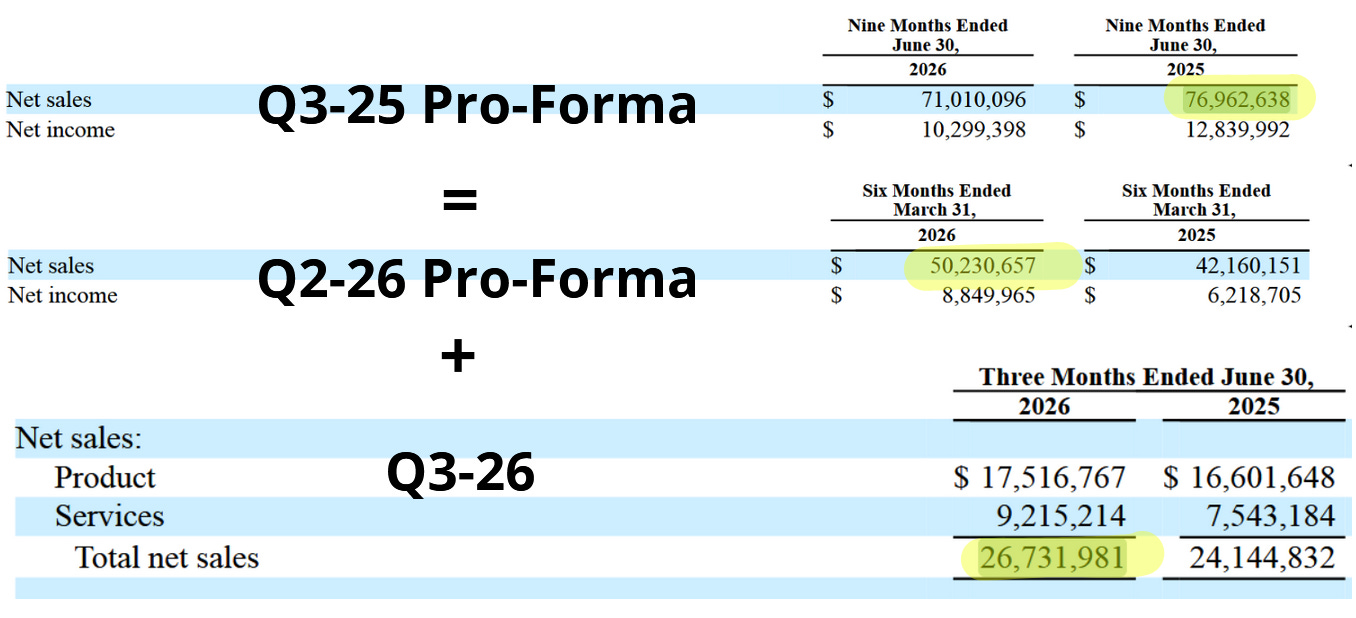
Column shift, formula dragged wrong, I have no idea. And even assuming the match is pure coincidence, it still doesn’t explain why pro forma revenue would shrink at all.
I’ve contacted the CFO about the potential error, obviously. I’ll keep you posted if anything useful comes back. It’s a shame. I would really have liked to compare the numbers over the period. Never mind, I’ll wait.
Luckily, ISSC put out a press release about a $50M contract to tide us over. And there’s a lot to say about it. Some of it essential.
The rest is for paid subscribers only.
I won’t try to convince you. That would waste both our time. I know for a fact: the people who go paid do it for the quality of the work. So I’ll let the work do its own marketing. Suit yourself.