
99 Years of Wisdom Condensed Into 40 Mental Models II
Charlie Munger's 40 Mental Models — Part II

I dug through decades of speeches, letters, and interviews of Charlie Munger to extract the mental models that, in my view, are the real gears behind his success.
I found 40. Here they are.
1. Reason-Respecting Tendency
You want to ask someone for something and maximize the odds they say yes. Tell them why. That’s it.
The advice could stand on its own. But humans are more… surprising than that. The probability increases even when the reason makes no sense.
In 1978, psychologist Ellen Langer ran a study where researchers tried to cut in line at a university copy machine using three different phrasings. Here are the results:
Simple request: “Excuse me, I have 5 pages. May I use the Xerox machine?” → 60% compliance
Request + real reason: “…because I’m in a rush” → 94% compliance
Request + nonsense reason: “…because I have to make copies” , completely tautological, everyone is there to make copies → 93% compliance
The real reason and the nonsense reason are virtually identical in effect. Replications showed weaker results for nonsense reasons, but still consistently higher than no reason at all.
But still, what a result!
It’s rare for Charlie to cite a study to support his point. But when he does, he picks well:
“Unfortunately, Reason-Respecting Tendency is so strong that even a person’s giving of meaningless or incorrect reasons will increase compliance with his orders and requests. This has been demonstrated in psychology experiments wherein “compliance practitioners” successfully jump to the head of the lines in front of copying machines by explaining their reason: “I have to make some copies.” This sort of unfortunate byproduct of Reason-Respecting Tendency is a conditioned reflex, based on a widespread appreciation of the importance of reasons. And, naturally, the practice of laying out various claptrap reasons is much used by commercial and cult “compliance practitioners” to help them get what they don’t deserve.”
— Poor Charlie’s Almanack, Peter D. Kaufman
2. Human = Gamed
You probably know Charlie’s famous line: “Show me the incentive and I’ll show you the outcome.” But that's just the punchline. The reasoning behind it is what makes it powerful.
His reasoning goes like this:
Every human system (family dynamics, tax codes, traffic laws) is built on arbitrary rules.
Each person will interpret and evaluate those arbitrary rules differently.
And from those interpretations, incentives emerge.
For example: I know I’m supposed to stop at a red light. But it’s 2 AM, no one’s around, and I won’t get caught. I run the light.
Scale that logic to every participant in every system, and you get Charlie’s premise:
“All human systems are gamed, for reasons rooted deeply in psychology, and great skill is displayed in the gaming because game theory has so much potential.”
— Charlie Munger, University of California Speech at Santa Barbara, 2003
People are not “intrinsically dishonest or bad”, it’s just that the rules are arbitrary and the incentives to bend them are not.
3. Cognitive Eccentricity
You probably know the famous anecdote about Charles Darwin: whenever he encountered a fact that contradicted his ideas, he would write it down immediately in a notebook, because he knew his brain would do everything in its power to forget it or distort it.
150 years later, cognitive psychology has obviously proven Darwin right. Our brains are wired to seek information that confirms our priors and reject what refutes them. Ironically, this is an adaptive reflex that served our evolutionary survival well. In a world where changing your mind about which berries are poisonous could kill you, stubbornness was a gift.
Where Charlie brings his wisdom is in how far this idea can carry someone. Doing what others are cognitively unwilling to do leads to outsized results: actively seeking to contradict your own ideas, being disliked without flinching, persisting through a string of failures, sitting still and doing nothing for decades. These are cognitive overrides, and the people who master them tend to end up in the history books, for better or for worse.
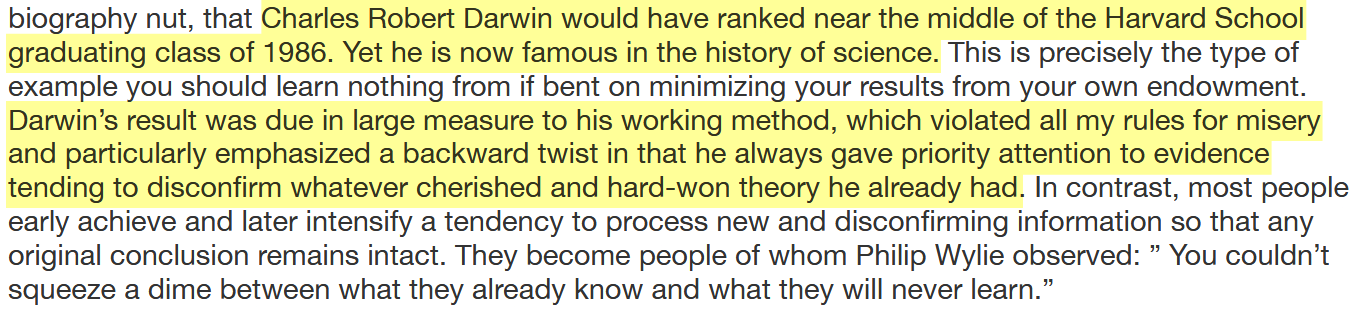
Ironically, Charlie Munger is himself one of the best examples of a “cognitive eccentricity” success story.
4. The Tolstoy Effect
Tolstoy observed that even the worst criminals don’t see themselves as bad people. They end up believing either that they didn’t commit their crimes, or that given the pressures and disadvantages of their lives, their behavior was understandable and forgivable.
Nobody is the villain of their own story. Charlie turns this observation into a principle:
“The Tolstoy effect, where the man makes excuses for his fixable but unfixed bad performance is bad character and tends to create more of itself, causing more damage to the excuse giver with each tolerated instance.”
— Poor Charlie’s Almanack, Peter D. Kaufman
Charlie does offer an antidote:
“The best antidote to folly from an excess of self-regard is to force yourself to be more objective when you are thinking about yourself, your family and friends, your property, and the value of your past and future activity.
This isn’t easy to do well and won’t work perfectly, but it will work much better than simply letting psychological nature take its normal course.”
— Poor Charlie’s Almanack, Peter D. Kaufman
5. Psychology of Human Misjudgement
Life is a human game. Practical psychology is the rulebook of that game, a rulebook that isn’t taught in school. One of Charlie Munger’s biggest learning regrets, by his own admission (one he spent the rest of his life correcting).
This discipline was so important to him that he did something he never did for anyone else: he gave one Berkshire Hathaway Class A share to Robert Cialdini, author of Influence: The Psychology of Persuasion, for ‘his contribution to mankind’ (roughly $250,000 at the time).
So the most useful and practical part of psychology-which I personally think can be taught to any intelligent person in a week-is ungodly important. And nobody taught it to me, by the way. I had to learn it later in life, one piece at a time. And it was fairly laborious. It’s so elementary though that, when it was all over, I just felt like a total horse’s ass. And yeah, I’d been educated at Caltech and the Harvard Law School and so forth. So very eminent places miseducated people like you and me. The elementary part of psychology-the psychology of misjudgment, as I call it-is a terribly important thing to learn.
— Poor Charlie’s Almanack, Peter D. Kaufman
I have a background in psychology, and I can say that not a single day has passed without it being useful to me. Definitely worth a few hundred or thousand hours of your life. Subscribe and let me do some of the work for you.
6. Availability-Misweighing Tendency
Here, Charlie is generous; he gives both the problem and its antidotes:
“Man’s imperfect, limited-capacity brain easily drifts into working with what’s easily available to it... An idea or a fact is not worth more merely because it is easily available to you.”
— Poor Charlie’s Almanack, Peter D. Kaufman
The main antidote to miscues from Availability Misweighing Tendency often involves procedures, including use of checklists, which are almost always helpful.
Another antidote is to behave somewhat like Darwin did when he emphasized disconfirming evidence. What should be done is to especially emphasize factors that don’t produce reams of easily available numbers, instead of drifting mostly or entirely into considering factors that do produce such numbers.
Still another antidote is to find and hire some skeptical, articulate people with far reaching minds to act as advocates for notions that are opposite to the incumbent notions.
— Poor Charlie’s Almanack, Peter D. Kaufman
The few times Charlie mentioned this tendency, he always used everyday examples, never investing. Yet it’s one of the most common and most costly mistakes in finance. I wrote a deep dive on exactly that:
7. Granny’s Rule
Granny’s Rule is the requirement that children eat their carrots before they get dessert.
Applied more broadly: do the unpleasant tasks before the pleasant ones. Pure behavioral engineering.
It’s a simple idea, but Charlie took it very seriously.
“‘Granny’s Rule’ provides another example of reward superpower, so extreme in its effects that it must be mentioned here. You can successfully manipulate your own behavior with this rule, even if you are using as rewards items that you already possess! Indeed, consultant PhD. psychologists often urge business organizations to improve their reward systems by teaching executives to use “Granny’s Rule” to govern their own daily behavior.”
— Poor Charlie’s Almanack, Peter D. Kaufman
Now, if I hadn’t told you this was Charlie Munger, you’d probably think I was being condescending. Eat your carrots before dessert, really?
And that’s precisely what makes Charlie Munger’s mental models so popular. Here’s someone who achieved more than most of us will ever aspire to, explaining that ideas this simple actually work. Ideas we tend to dismiss precisely because they’re simple, when they’re not backed by a lifetime of success to vouch for their quality.
That dismissal is a massive mistake. The quality of a simple idea should not depend on who said it. And that’s one of the traits that made Charlie who he is: the ability to recognize a good idea regardless of where it comes from, and apply it across a wide range of situations. His pool of good ideas was therefore larger than most people’s, and the arsenal he built from it compounded faster.
So let me use this Granny’s Rule to offer a mental model of my own using Charlie as an example: judge the quality of an idea independently of who said it.
8. Two-Track Analysis
Charlie believed almost every decision should be analyzed from two angles, the rational and the psychological:
“Personally, I’ve gotten so that I now use a kind of two-track analysis. First, what are the factors that really govern the interests involved, rationally considered? And second, what are the subconscious influences where the brain at a subconscious level is automatically doing these things-which, by and large, are useful but which often misfunction?
One approach is rationality-the way you’d work out a bridge problem: by evaluating the real interests, the real probability, and so forth. And the other is to evaluate the psychological factors that cause subconscious conclusions-many of which are wrong.”
— Poor Charlie’s Almanack, Peter D. Kaufman
I’ll add a third track, one that’s often forgotten and too easily dismissed as irrationality: constraints.
Constraints of time, means, motivation, interests, power, etc. When a decision seems irrational, asking what constraints might have caused that behavior is often wiser than stopping at “irrationality.” Nine times out of ten, the person wasn’t being irrational, they just didn’t have the options people think they had.
9. Survival of the Simplest
“Take a simple idea, but take it seriously.”
— Charlie Munger
This one is special. It’s probably one of Charlie’s most insightful mental models, but it suffers from the very defect that makes it so insightful in the first place: it’s too simple. Ironically, this mental model is itself a simple idea, worth taking seriously.
Our brain doesn’t perceive reality. It perceives change. We don’t feel heat; we feel a change in heat. We don’t hear volume; we hear a change in volume. Psychophysics calls this the Weber-Fechner law: our sensitivity is proportional to the magnitude of the stimulus. The bigger the reference point, the less we notice small variations.
This wiring has a decisive consequence for decision-making: we systematically neglect small, consistent actions because they feel insignificant compared to the outcome we’re chasing.
Who invests $100 a week for 30 years to become a millionaire? Almost nobody. The action is too small relative to the goal. So people look for more spectacular paths that feel proportional to the ambition: lottery tickets, speculation, the next big thing.
Anyone who can take a simple idea with modest short-term consequences and commit to it seriously over a long period will inevitably become exceptional. An athlete, an investor, a musician.
“Think about everything in the simplest way, and act with seriousness.”
— Charlie Munger
10. N-Order Effects
When Medicare was first introduced, a panel of experts (including PhD economists) projected its cost using simple extrapolations of past data. They were off by a factor of more than ten.
New incentives changed behavior, changed behavior changed costs, changed costs changed everything downstream. Basically, they rounded Pi to 3.2 and called it a forecast.
“Too little attention is given to second order and even higher order effects. The consequences have consequences, and the consequences of the consequences have consequences, and so on.”
— Charlie Munger, University of California Speech at Santa Barbara, 2003
11. Latticework of Models
Isolated facts are dead weight. A fact only becomes useful when it’s connected to other facts through a structure (a theory, a model, a pattern). Without that structure, you’re just memorizing. With it, you’re thinking.
“You can’t really know anything if you just remember isolated facts and try and bang ‘em back. If the facts don’t hang together on a latticework of theory, you don’t have them in a usable form.”
— Charlie Munger, Talk at USC Business School, 1994
Charlie estimates he uses about a hundred models. That sounds like a lot. But most of the heavy lifting is done by a handful, borrowed from math, psychology, physics, biology, and engineering. The rest builds on top.
“You have to learn many things in such a way that they’re in a mental latticework in your head and you automatically use them the rest of your life. If many of you try that, I solemnly promise that one day most will correctly come to think: ‘Somehow I have become one of the most effective people in my whole age cohort.’ And, in contrast, if no effort is made toward such multidisciplinarity, many of the brightest of you will live in the middle ranks, or in the shallows.”
— Charlie Munger, USC Commencement Speech, 2007
I’ve started building this latticework in public: 50 mental models extracted from across all disciplines. 15 are published, 35 to go. I’ll release them all at once, when everything is final. Months of work left. One inch at a time. Be there when it lands.
12. Physics Envy
What discipline doesn’t envy the natural elegance of physics? A few variables, a few operations, an equals sign, and there it is, a beautiful formula for the history books.
But the further down the chain of causes and consequences a discipline sits, the more illusory those formulas become. Anything involving human behavior falls into that category. Economics obviously qualifies. And yet it’s probably the discipline most jealous of physics. This isn’t a new problem: a century ago, Keynes was already making the same reproach to his peers.
“To convert a model into a quantitative formula is to destroy its usefulness as an instrument of thought.”
— John Maynard Keynes
Charlie Munger was one of the most vocal critics of this physics envy in economics, and he never missed an opportunity to remind people of it throughout his life.
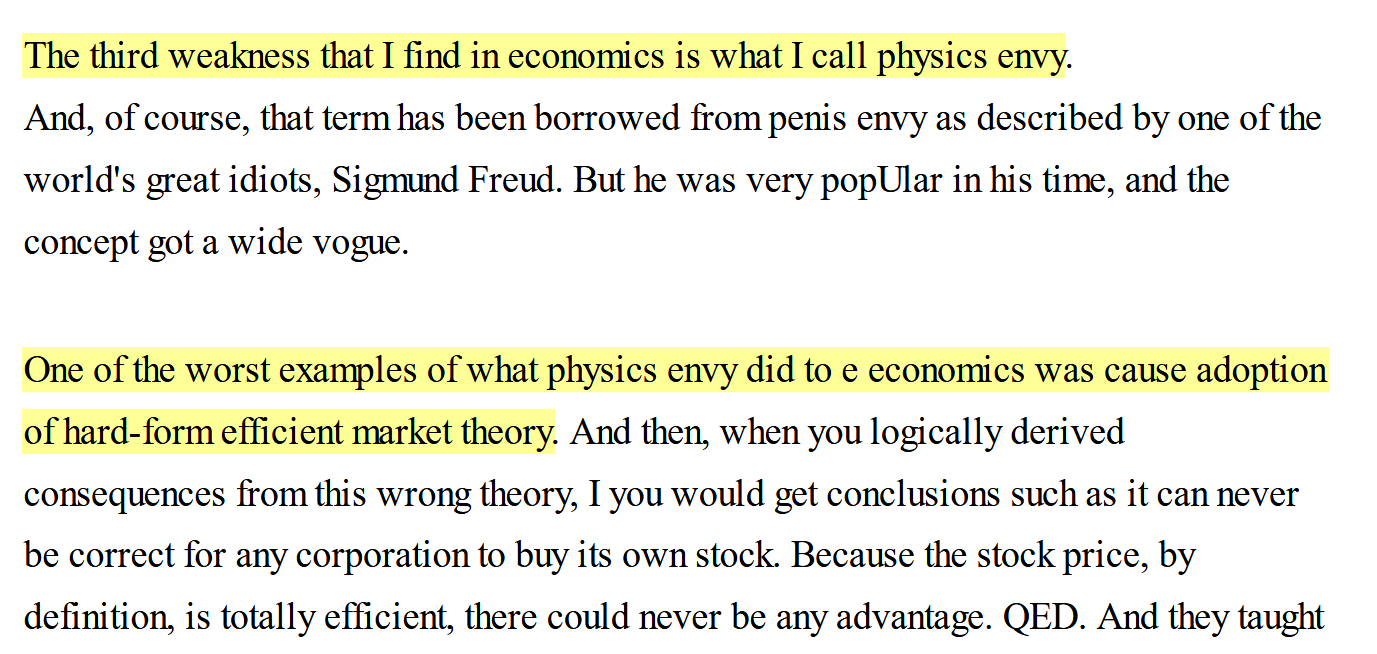
Envy has never built anything, in academia or anywhere else.
13. Overweighing-What-Can-Be-Counted
Charlie said it better than I could:
“You’ve got a complex system and it spews out a lot of wonderful numbers that enable you to measure some factors. But there are other factors that are terribly important, [yet] there’s no precise numbering you can put to these factors. You know they’re important, but you don’t have the numbers. Well practically everybody (1) overweighs the stuff that can be numbered, because it yields to the statistical techniques they’re taught in academia, and (2) doesn’t mix in the hard-to-measure stuff that may be more important. That is a mistake I’ve tried all my life to avoid, and I have no regrets for having done that.”
— Charlie Munger, University of California Speech at Santa Barbara, 2003
This is exactly how Wall Street operates. The entire industry is built on what can be measured, and almost structurally blind to what can’t. Culture, management quality, incentive alignment, optionality, no Bloomberg terminal spits those out. Which is precisely where the edge is.
14. Surfing
Sometimes, winning is just a matter of surf: spot a wave, position yourself, and ride it.
According to Charlie, these skills are all the more essential in an era where technological revolutions chain together.
“When technology moves as fast as it does in a civilization like ours, you get a phenomenon which I call competitive destruction… You either get into a different business or you’re dead—you’re destroyed… And when these new businesses come in, there are huge advantages for the early birds. And when you’re an early bird, there’s a model that I call “surfing”—when a surfer gets up and catches the wave and just stays there, he can go a long, long time. But if he gets off the wave, he becomes mired in shallows…”
— Charlie Munger, talk at USC Business School 1994
He said this in 1994. 30 years later, the waves have only gotten bigger. And coming from a man who built his fortune on patience, that's not nothing.
15. The Social Cost of Good Decisions
Saying no when everyone around you is saying yes has a cost that most people aren't willing to pay.
“A lot of success in life and business comes from knowing what you want to avoid: early death, a bad marriage, etc. Just avoid things like AIDS situations, racing trains to the crossing, and doing cocaine, etc., develop good mental habits… If your new behavior earns a little temporary unpopularity with your peer group then the hell with them.”
— Poor Charlie’s Almanack, Peter D. Kaufman
By choosing your peer group well, you can reduce the social cost, or even turn it into a gain. Which makes it a huge incentive to choose your peer group carefully, even if it means changing it entirely.
16. The Human Brand Moat
A brand reduces friction. You trust it, so you stop searching. Coca-Cola, Apple, Costco, you buy without thinking twice.
Charlie argued that the same moat applies to people, and must be actively built:
“You want to deliver to the world what you would buy if you were on the other end. There is no ethos in my opinion that is better for any lawyer or any other person to have. By and large, the people who’ve had this ethos win in life, and they don’t win just money and honors. They win the respect, the deserved trust of the people they deal with. And there is huge pleasure in life to be obtained from getting deserved trust.”
— Poor Charlie’s Almanack, Peter D. Kaufman
17. Business > Manager
2026 will be a big year for IPOs, or, as some on Wall Street call them, “It's Probably Overpriced”, and most of them will be sold on the founder's story.
Charlie's warning has rarely been more relevant:
“Averaged out, betting on the quality of a business is better than betting on the quality of management. In other words, if you have to choose one, bet on the business momentum, not the brilliance of the manager.”
— Charlie Munger, Talk at USC Business School, 1994
18. The Cancer Surgery Formula
When something in your life is a mess: a career, a relationship, a set of habits, a portfolio, the basic instinct is to try to fix everything. According to Charlie, the wiser move is the opposite: find what's sound, and cut away everything else.
It’s the mirror image of inversion: instead of asking “what should I add to make this work?”, ask “what should I remove so that what already works can breathe?”
“They [GEICO] look at this mess. And they figure out if there’s anything sound left that can live on its own if they cut away everything else. And if they find anything sound, they just cut away everything else. Of course, if that doesn’t work, they liquidate. But it frequently does work.”
— Charlie Munger, Talk at USC Business School, 1994
At its core, the Cancer Surgery Formula is just a concrete application of one of Charlie's deepest convictions:
“It is remarkable how much long-term advantage people like us have gotten by trying to be consistently not stupid, instead of trying to be very intelligent.”
— Charlie Munger, Berkshire Hathaway Meeting 2001
Cancer surgery is just consistent non-stupidity with a scalpel.
19. The Whirlpool Principle
“Some Scandinavian canoeists succeeded in getting through all the rapids of Scandinavia, and they thought they would continue their success by tackling the big whirlpools in northwest America. The death rate was one hundred percent.”
— Charlie Munger, Harvard School Commencement Speech, 1986
They died because they assumed the skill they had was the skill they needed.
Charlie adds a second layer: the canoeists went as a group. Each one’s confidence reinforced the others’. In this example, social proof turned individual overconfidence into collective suicide.
“A big whirlpool is something you want to avoid. And I think the same is true about intense ideology, particularly when your companions are all true believers.”
— Charlie Munger, Harvard School Commencement Speech, 1986
Charlie spent so much of his life denouncing ideology that I don't even need to look for another quote. He's already said it all.
20. Learning as a Categorical Imperative
This is one of the purest forms of mental model there is, a heuristic: a way to make an optimal decision very quickly and at minimal cost.
No more hesitating between leisure and learning, just learn. It’s a moral duty. A “universal law,” as Kant would say.
Of course, it’s just a cognitive trick, a way of dictating to ourselves the behavior to follow without thinking. But it’s a trick that depends primarily on our willingness to make it work (or not), which is pretty remarkable when you think about it.
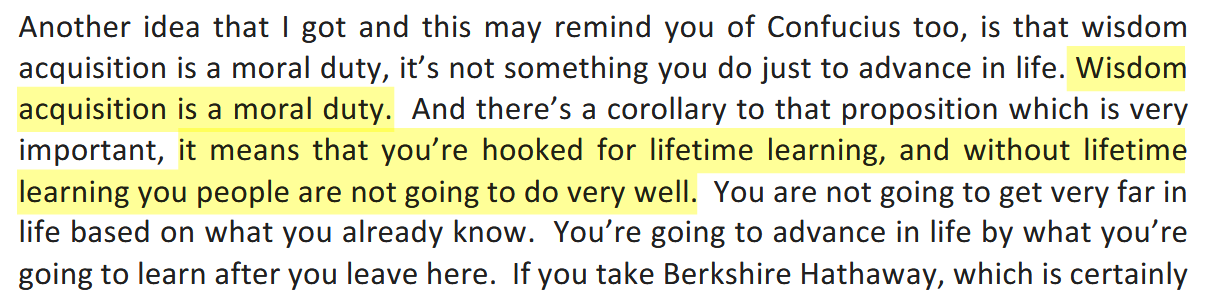
Wisdom acquisition is a moral duty.
Charlie left the perfect ending himself:
“I hope these ruminations of an old man are useful to you. In the end I’m like old Valiant-for-truth in The Pilgrim’s Progress:
My sword I leave to him who can wear it.”
Rest easy, Charlie. The sword found hands.
Take care,
Flo

This is an exceptional synthesis. What usually gets lost in the Munger-isms is exactly what you’ve highlighted here: the interconnectivity of these models. Most people treat them like a checklist; Charlie treated them like a biological system.
I particularly loved that The Human Brand Moat was included. Fortunately, I came across it when very young and used it as a guiding principle throughout my life and career.
This is a resource I’ll be coming back to; thank you for this excellent article!