
The Biggest Myth in Behavioral Finance
Why most behavioral finance advice weighs you down instead of helping you.

No TL;DR this time. It would ruin the payoff. I’ll give you the conclusion up front and let the story do the work:
Without emotion, you’re less rational, and you end up losing more and winning less in economic decision-making.
The study I’m about to discuss is so counterintuitive that we need to be on the same wavelength from the very beginning.
The best part is that we’ll only need a few cards.
So please set your intuition aside for a few minutes, and let’s look at one of the most striking findings I’ve come across in cognitive science.
I Want to Play a Game
You have four decks of cards in front of you. Each card in each deck is associated with both a gain and a loss.
Your goal: earn as much money as possible over 100 draws.
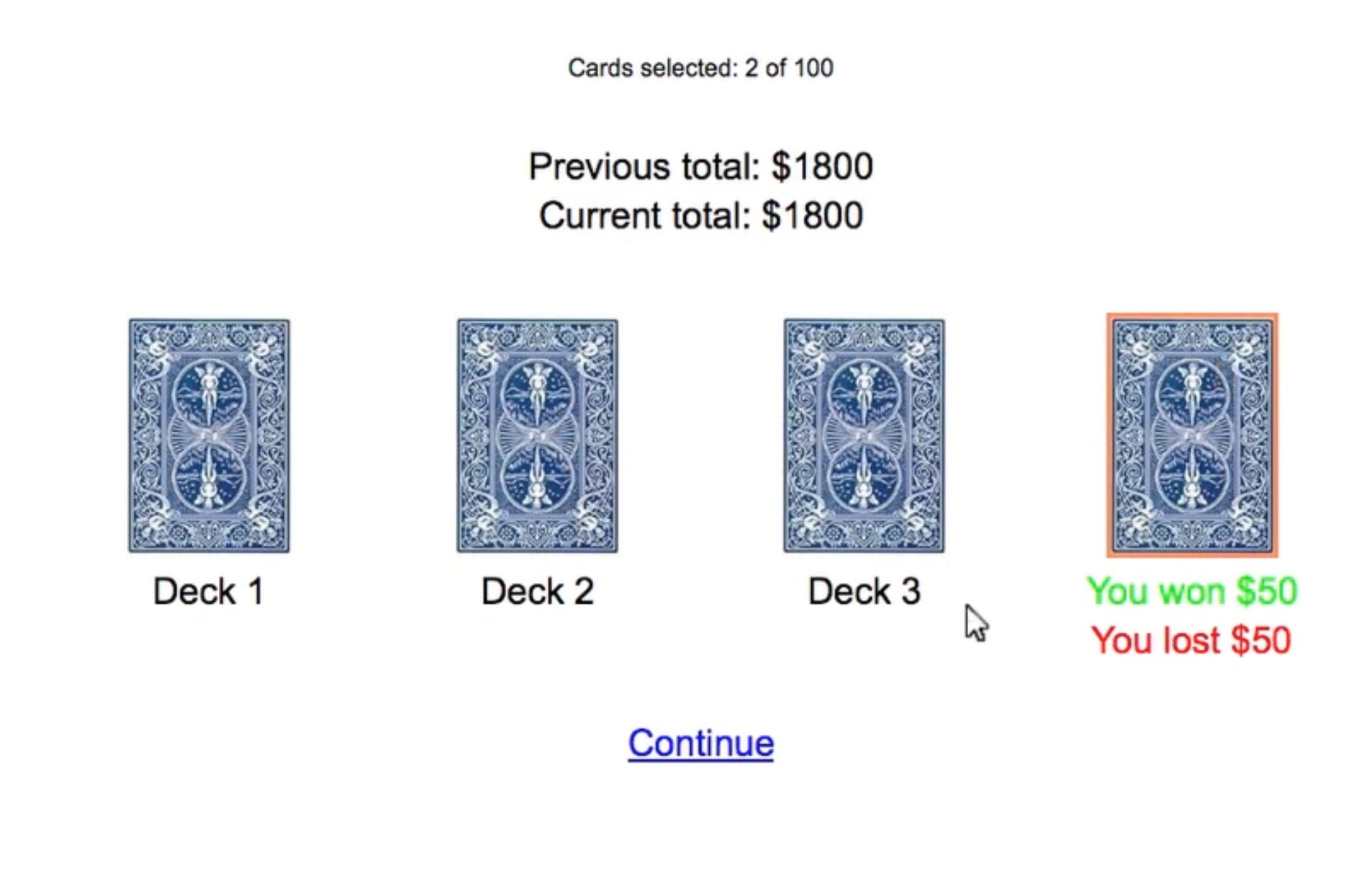
The gains aren’t distributed randomly across the decks. Of course, participants don’t know that.
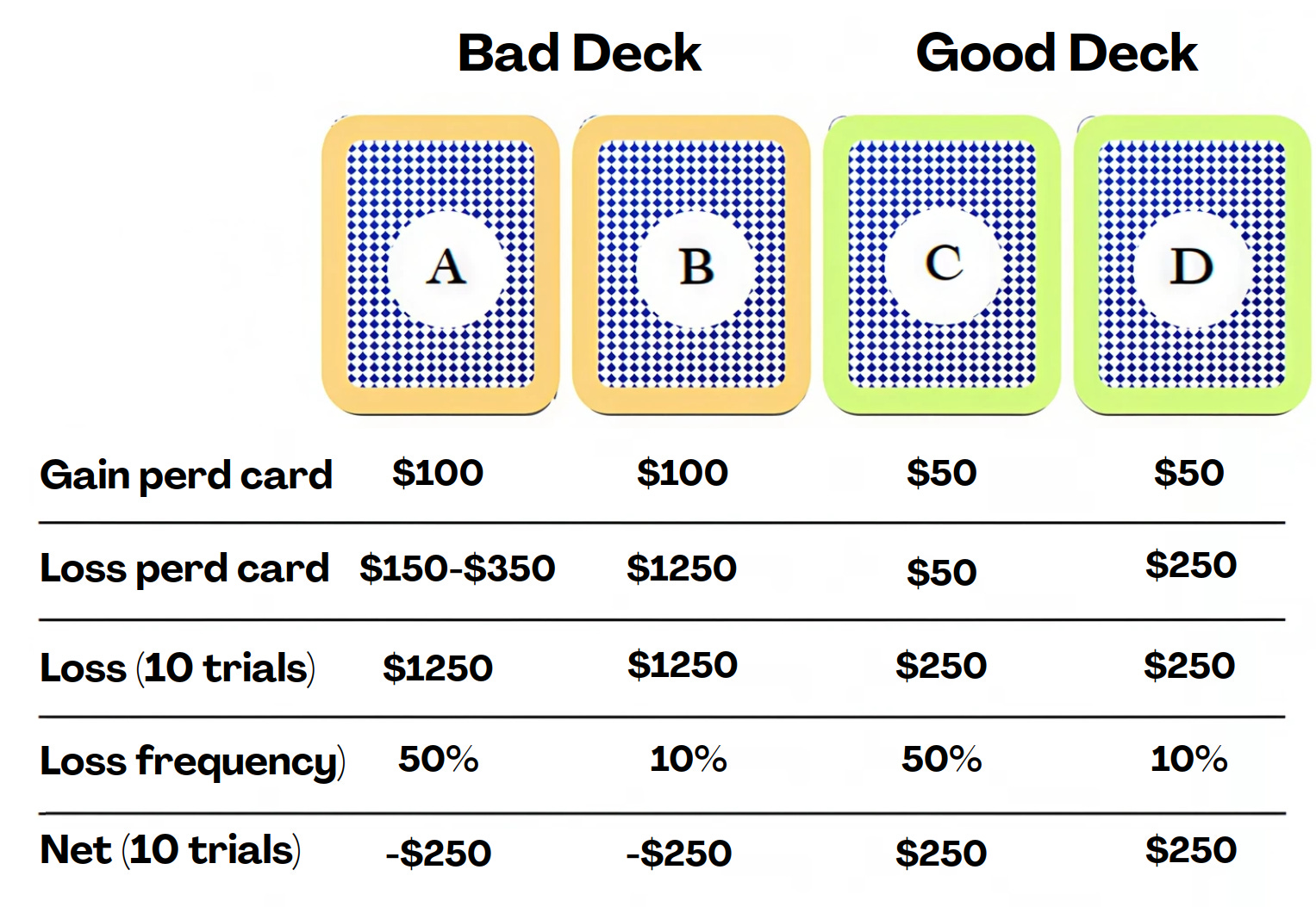
There are two types of decks:
Two “dangerous” decks, 1 and 2, with many large gains at the beginning but even larger losses afterward → negative expected value (the average payoff over time)
Two “advantageous” decks, 3 and 4, with more modest gains but smaller losses → positive expected value
As the draws pile up, participants’ attention and memory get swamped by the game’s complexity.
In general, a typical human will behave in the following way:
An exploration phase over the first 10-20 draws, with a focus on decks 1 and 2 because of the large initial gains.
A discomfort phase over the next 20-50 draws, as the large losses from decks 1 and 2 appear, along with a new phase of re-exploration.
An adaptation phase in which most participants draw the majority of their cards from decks 3 and 4 after 50 draws until the end.
So far, nothing remarkable. But here is the first really interesting point: if we stop the game around the 40th-50th trial and ask the participants to explain the structure of the decks, most of them are unable to do so.
They hesitate, put forward hypotheses that they end up admitting are random guesses, and sometimes contradict themselves from one sentence to the next.
Yet, at this stage, we already observe a clear movement: they abandon decks 1 and 2 and concentrate more and more on decks 3 and 4.
Their behavior adjusts, but they themselves still cannot say why. Sometimes, they don’t even realize that their behavior is adjusting.
This can seem very counterintuitive, but having administered this task to hundreds of participants myself, I assure you these behaviors are real. I remember participants who could choose decks 3 and 4 for ten consecutive trials and justify it as chance, without being aware of their preference.
One hypothesis to explain this would be that participants take into account information that pushes them to make different decisions, without the processing of that information, or its consequences, being consciously perceived.
But to test this hypothesis, we’re going to need atypical humans.
I Want to Play a Game, but Not with You
This time, I play the same game again, but with people who have lesions in the prefrontal cortex, a brain region that is heavily involved in decision-making.
At the beginning, everything happens just as it does with typical participants. They explore the different decks, let themselves be drawn to the large gains in decks 1 and 2. Nothing unusual.
However, once past the 30th trial, most of these participants stay attached to the dangerous decks, despite the large losses that silently accumulate. Remember that healthy participants, by contrast, had already started to drift away from decks 1 and 2 at this point, without even realizing it.
And the divergence continues. All the way to the end, participants with brain damage remain primarily focused on decks 1 and 2.
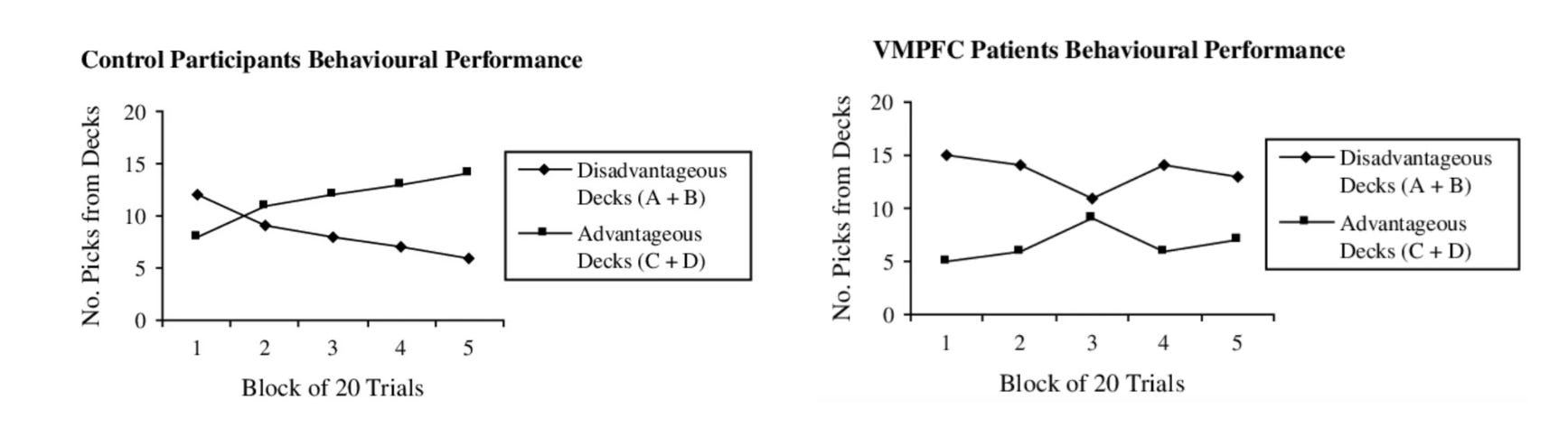
So, participants with a lesion in the prefrontal cortex tend to converge on sequences of decisions that are economically catastrophic. Yet:
their IQ is normal,
their abstract reasoning is intact,
and the same goes for their memory.
They are just as intelligent and intellectually capable as you and I.
However, they show an impaired ability to generate and use anticipatory bodily signals that normally bias choices under uncertainty.
When Feeling Leads to Better Decisions
In typical participants, we can observe physiological signals at very specific moments.
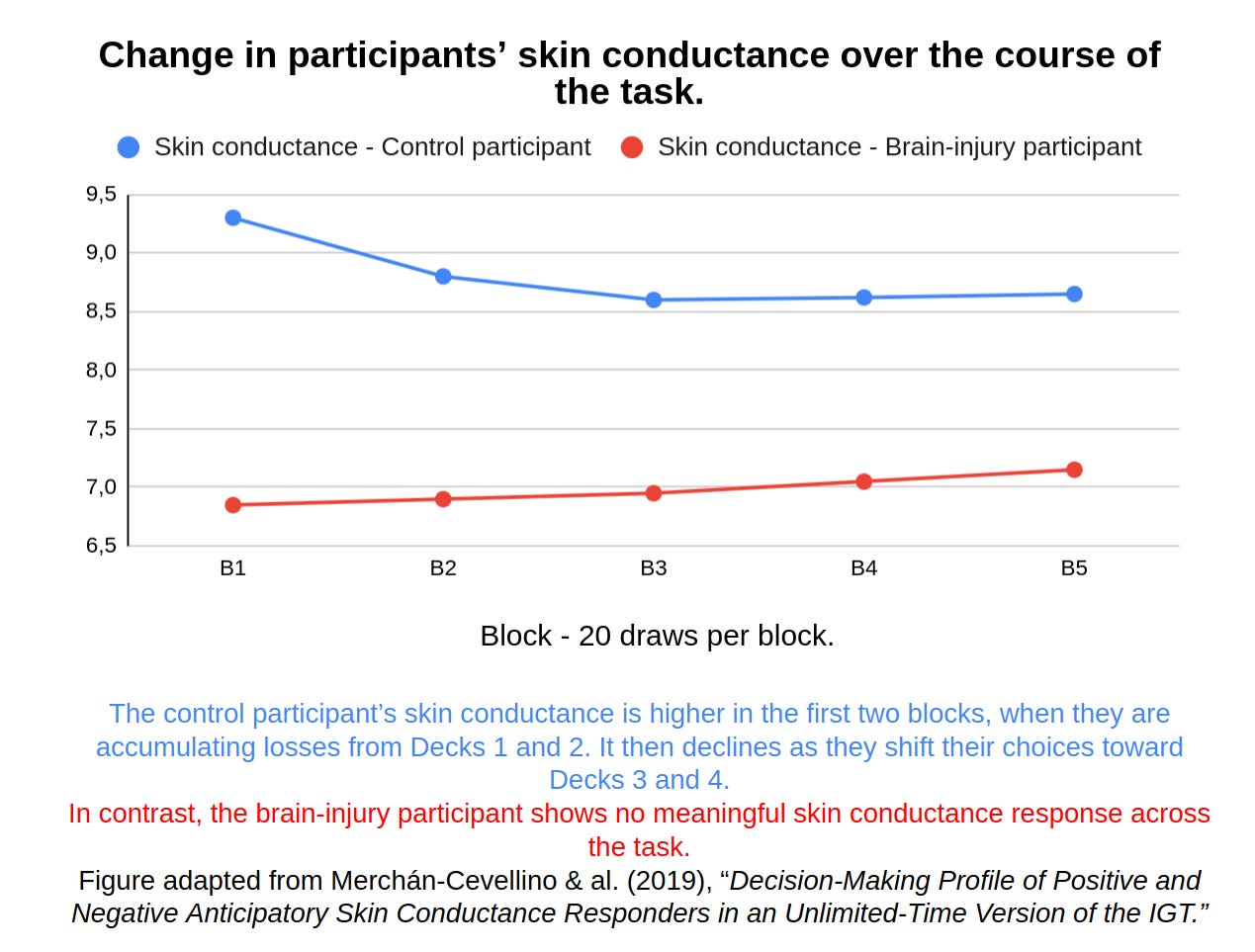
After a major loss from a given deck, participants later show a subtle increase in hand sweating, which is measured by skin conductance. This response is triggered when their hand moves toward that same deck on subsequent trials, just before a new card is drawn.
This is incredible when you think about it. The body produces a signal anticipating an outcome without participants being aware of the signal, the anticipation, or even the outcome itself.
I’m emphasizing this last part because it’s central:
Someone who pulls a card from deck 1 and takes a big loss,
then draws other cards afterward and later goes back to deck 1,
will show a higher skin conductance at the moment their hand moves toward deck 1,
even if the person can’t explicitly recall the loss or explain why the deck feels risky.
Our nervous system is tracking risk through bodily signals before we can articulate it.
This is what is called a somatic marker1: an anticipatory and unconscious bodily signal formed through very rapid unconscious conditioning (e.g., after a big loss/win).
And that’s exactly what the participants with damage to the prefrontal cortex are missing. They’re unable to generate these signals and to factor them in unconsciously when they make decisions:
Somatic markers are tools evolution has “given” us to deal with the complexity of our environment:
They create fast, unconscious conditioning based on past outcomes.
They generate bodily signals when a similar situation or action is encountered again.
They allow the brain to form associations at a very low energetic cost.
They bypass the limits of conscious reasoning in environments where causes and consequences are complex (delayed, opaque, etc.)
They are bodily heuristics that summarize accumulated experience and make the decision much more manageable. The only “problem” is that these markers, their processing, and their integration into decision-making remain largely unconscious.
Great, that’s very interesting and all, but what does this have to do with emotions?
It’s simple: somatic markers are among the raw materials of emotions.
When these physiological changes repeat and the brain interprets them in a context, they translate into a general feeling: fear, apprehension, relief, confidence, etc.
In other words, an emotion is the more or less conscious interpretation of these bodily signals (increased heart rate, pupil dilation, muscle tension, micro-sweating, and so on).2
This is exactly what participants with lesions in the prefrontal cortex are missing. Because of these lesions, they lose the ability to generate somatic markers (emotional, unconscious signals) and, as a result, to integrate them into their decisions.
They are not able to choose the better decks over time because the complexity of the game and the amount of information to process are simply too much for their conscious mind.
They do not have the physiological/emotional “shortcuts” needed to handle that complexity effectively.
That is an example of how emotional signals allow you to make better “rational” and economically viable decisions.3
This study was pioneering in showing the inconsistency of the rationality/emotion dichotomy, and many others followed.
Today, it is widely accepted among specialists that emotions are an essential component of our decision-making, compensating for certain limitations of our brains when facing the complexity of our environment (at the cost of other flaws, of course, which we call cognitive biases).
But what does this imply for an investor?
Emotion Drives Reason, So What?
Trying to be purely rational goes against how your body and brain are built. It’s like trying to fly by flapping your arms: it’s a waste of energy.
As an investor, your job is to understand how your brain makes decisions. It’s not optional; your long-term performance depends directly on it.
The biggest mistakes great investors make usually don’t come from bad valuation work or misunderstanding a business, but from poor decision-making (panic, lack of patience, etc.).
Making better decisions is a mix of knowledge and skill:
Knowledge helps you acquire skills faster and more effectively.
Skills sometimes let you “(re)discover” knowledge.
For the skill side, it’s on you to extract as much information as possible from both your mistakes and your successes.
On the knowledge side, here’s a strong starting point I’ve put together with care:
Unfortunately, I wasted my conclusion in the introduction, and now I’m left with nothing.
So I’ll close with a fitting quote:
“We are not thinking machines that feel; we are feeling machines that think.”
Antonio Damasio
If you feel this helped, think about subscribing.
If you think it’s worth sharing, feel free to share.
“Somatic markers” is the term coined by Antonio Damasio, the author of the study I’m citing here (among many others), who helped open the way to an integrated view of rationality and emotion. Here are the main references:
The original study: Bechara, A., Damasio, H., Tranel, D., & Damasio, A.R. (1997). “Deciding advantageously before knowing the advantageous strategy.” Science.
The theory had largely been laid out in Damasio’s book three years earlier: Damasio, A.R. (1994). Descartes’ Error: Emotion, Reason, and the Human Brain.
One of the most hotly debated topics in cognitive psychology is how to define an emotion. You’ll find dozens of definitions, some of them frankly quite… counterintuitive. Without going into too much detail, let’s just say that physiological signals like the ones mentioned in this post are, in most definitions, the main component (if not the only one).
As with all pioneering studies, there’s still some debate about how to interpret certain findings. But the core result, the focus of this post, is widely accepted.
Insightful article. Thank you