
I Can (Almost) Predict Whether You'll Panic Sell
Yet it is one of the rarest.

The exercise of free will across millions of humans should, in theory, produce a messy, random sequence of behaviors.
In practice, human behavior turns out to be remarkably standardized and predictable.
Investing is no exception, especially in situations where decisions are driven by emotion.
Panic selling is the perfect example.
Panic selling is so predictable that a simple neural network with a few layers can predict with about 70-80% accuracy who will panic-sell and who won’t.
But the people who panic-sell the most aren’t necessarily the ones you’d expect.
In fact, the very fact that you’re reading this post increases your chances of panic-selling. However, stopping here won’t “rebalance” the probabilities, fortunately for me.
Let’s examine how panic selling shows up in the real world, and why it defies intuition.
Laying the Foundations
Fortunately for us, Elkind and his colleagues had the brilliant idea of digging into all of this.1
To do so, they:
Collected data from more than 650,000 portfolios held at U.S. brokerages, corresponding to 300,000 households over the period 2003-2015.
This dataset includes monthly snapshots of each portfolio, full trading histories, and demographic information about the account holders.
From there, they define panic selling as a situation in which an investor’s equity portfolio:
drops by at least 90% in a single month,
with at least half of the loss caused by the investor’s own sales (not just market price declines).
Note that this is a rather extreme definition of panic selling, especially the -90% drop in a single month.
How They Panic-Sell
First counterintuitive point: panic selling is relatively persistent over time, not just a phenomenon that appears during crises.
In months with steep market declines, the number of panic sellers is only about three times higher (0.3% of individuals) than in normal months (0.1%).
Even in a bull market, roughly 1 in 1,000 investors2 experiences a -90% drop in a given month, compared with only 3 in 1,000 during major downturns.
This pattern also appears in the individual frequency of panic selling:
Around 9% of investors panic-sold at least once over the period.
80% of them did it only once, 11.4% did it twice, and the rest trail off from there (let’s acknowledge the iron will of the four participants who still came back after 13 panic sells.)3
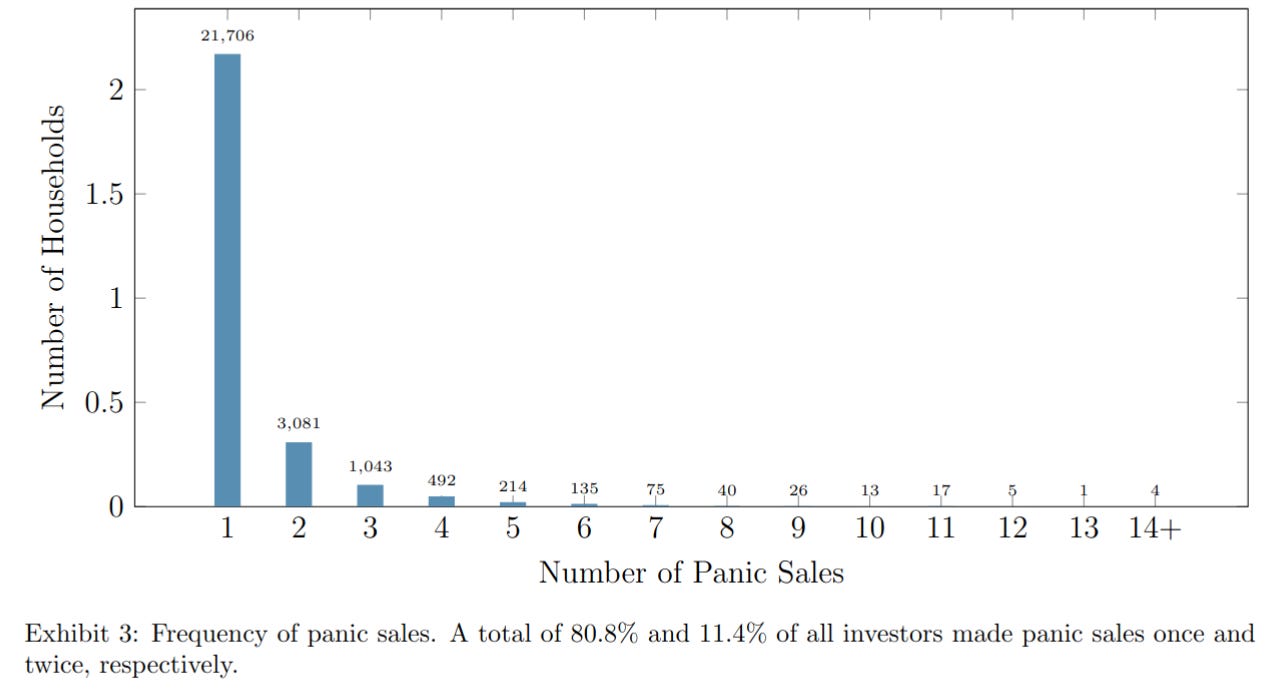
Extreme panic selling is therefore a relatively steady phenomenon, and most investors do learn from their mistakes.
The problem is that it’s just not always the “right” lesson: 30.9% of those who panic-sold were never “back in the market.”4
This brings us now to analyzing the individuals rather than the processes.
Who Panic-Sold
Socio-Demographic Profile
While people from all backgrounds can panic-sell, certain traits are clearly overrepresented.
Let’s move from the least predictive factors to the most predictive ones.
Gender
Gender has little impact on whether you panic-sell, but it does affect when:
Women are more likely to panic-sell outside of crisis periods.
Men are more likely to panic-sell during crises.
Occupation
Occupation matters more. You are significantly more likely to panic-sell if you are:
self-employed or an independent contractor
a business owner
in real estate
Conversely, you are significantly less likely to panic-sell if you are:
a paralegal (e.g., legal assistants)
a minor (likely because most accounts are custodial)
a social worker
Marital Status and Family Profile
Risk increases further if you are:
married or divorced,
between 45 and 75 years old,
responsible for a large number of dependents.
In that case, your likelihood of panic selling is significantly higher (and it increases with each additional dependent).
It’s not exactly “great” to be a 55-year-old divorced business owner with four dependents.
But there’s something even worse: a 55-year-old divorced business owner with four dependents who thinks he’s highly competent and highly experienced at investing.
Perceived Competence
If your answers to those two questions
What is your level of investment experience?
How would you describe your investment knowledge?
… are “good” or higher, then congratulations: you belong to the group most likely to panic-sell (most likely, not destined; this isn’t a personal attack).
The data is clear: the more confident you are in your investing experience and knowledge, the more likely you are to panic sell.5
Conversely, the more you consider yourself inexperienced or lacking knowledge, the less likely you are to panic sell.
Some might be quick to invoke the ever-present specter of the Dunning–Kruger effect6, but that explanation is probably too simplistic (as so often happens with this effect).
Several confounding factors are likely at play, including:
Less experienced investors monitor markets less frequently, so they mechanically have fewer opportunities to panic sell.
More experienced investors tend to have a larger share of their wealth in equities, meaning they have more at stake and are more emotionally exposed, naturally increasing the probability of panic selling.
“Panic” implicitly suggests an emotional decision and, by association, a bad one. But is that really true?
Is Panic Selling Really a Bad Idea?
Let’s examine the performance of panic sellers using my preferred lens: opportunity cost.
Here is the distribution of opportunity costs based on time spent out of the market during the 2008 crisis:
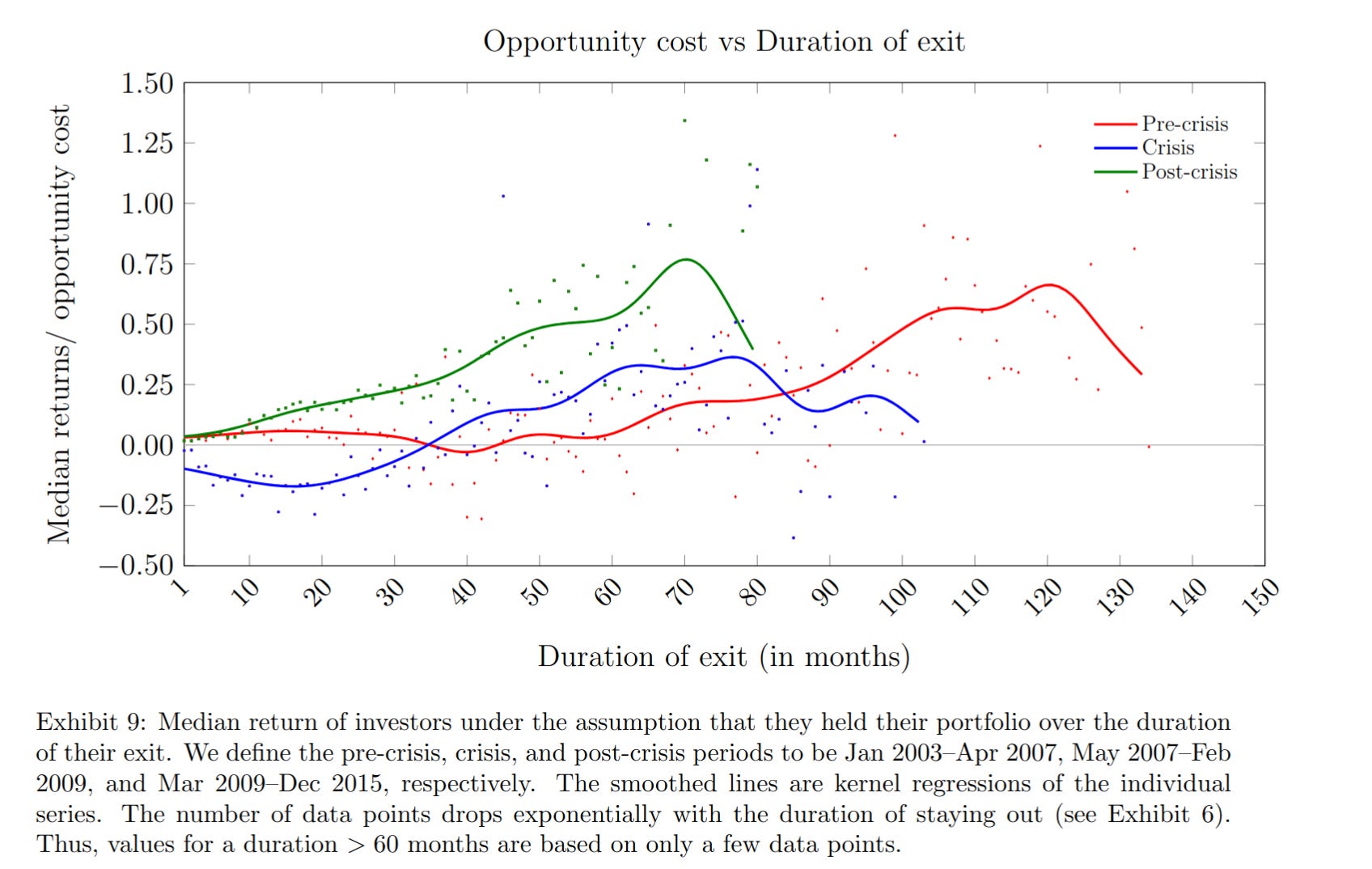
This chart highlights two important results:
First, panic selling outside a major drawdown (either before or after) comes with a very large opportunity cost.
Second, panic selling during the crisis can lead to immediate outperformance, and in many cases, continued outperformance for several years afterward.
Panic selling during the crisis could have been a reasonable move, since it gives several years of relative outperformance to confirm that the downturn has truly run its course.
However, most people who panic-sold weren’t following any kind of plan, and their subsequent performance shows it:
“The median investor trades infrequently and makes zero to negative returns when out of the market for periods between one month and five years.”
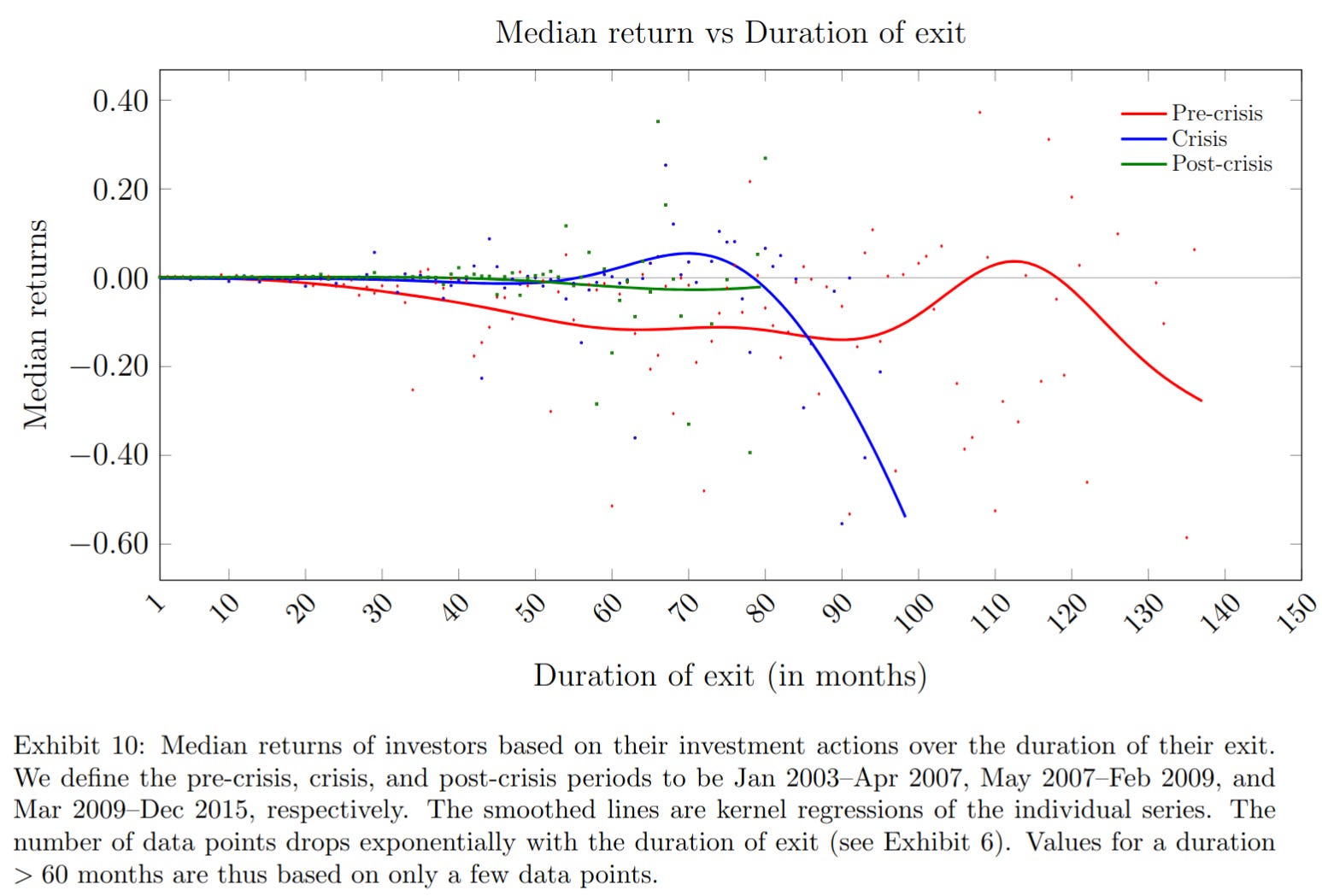
In the end, panic selling can be a major source of performance, but only if you panic intelligently and at the right moment.7
The problem is that the opportunity cost of leaving the market at the wrong time can be enormous.
High reward but high risk. Proceed at your own peril.
“Avoiding stupidity is easier than seeking brilliance.” - Charlie Munger
Take care,
Flo

Elkind, D., Kaminski, K., Lo, A. W., Siah, K. W., & Wong, C. H. (2022). When do investors freak out? Machine learning predictions of panic selling.
From this point on, I’ll treat each household as a single investor. This makes the results more concrete and easier to interpret, at the cost of a few subtleties that aren’t particularly material.
Note that the number of panic-selling events may be capped by the number of times an individual’s portfolio has dropped by 90%.
The authors define an investor as “back in the market” after a panic-sell if both of the following conditions are met:
The portfolio recovered to at least 50% of its pre–panic-sell value, and
The investor repurchased at least 50% of the amount they sold during the panic event.
The only factor that is (slightly) more predictive is having five dependents and working in real estate. But since the sample period overlaps almost perfectly with the subprime crisis, the likelihood that the real estate effect is just a sampling bias seems quite high.
The Dunning–Kruger effect is commonly described as the tendency for people to overestimate their knowledge or skills in a given domain, especially when they are the least competent.
However, psychologists have increasingly questioned the strength of this effect, suggesting that it may largely reflect statistical artifacts rather than a genuine cognitive bias. Its widespread popularity likely stems from how intuitively easy it is to grasp and from the way it conveniently reinforces certain prevailing beliefs.
Ironically, those who invoke the Dunning–Kruger effect at every turn often fall victim to it themselves. It’s hard not to appreciate the tautology.
To explore the topic further:
Gignac, G. E., & Zajenkowski, M. (2020). The Dunning-Kruger effect is (mostly) a statistical artefact: Valid approaches to testing the hypothesis with individual differences data. Intelligence, 80, 101449.
Lebuda, I., Hofer, G., Rominger, C., & Benedek, M. (2024). No strong support for a Dunning–Kruger effect in creativity: analyses of self-assessment in absolute and relative terms. Scientific reports, 14(1), 11883.
These conclusions are based on data limited to U.S. accounts from 2003-2015 and may not be generalizable.
so giving this a second read after seeingyour note, how do you differentiate panic selling versus thesis broken sell? does time of consideration of selling make it not a panic sell?
because i would argue the more experienced investors know not to sell which thus makes them experience because they have through “hard times” in the market which typically just come and go
i would argue those who did not sell during the trumpcession of 2025 did not panic sell and thus were actually the experienced investors
great read