
Why Smart Investors Should Scare You More Than Bad Ones
The story of a 4x I'm glad I missed.

When you spend a thousand hours at something, you recognize someone who has too.
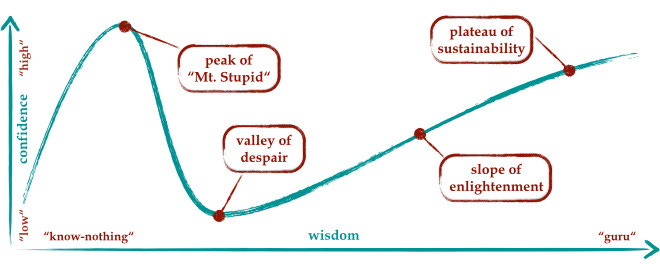
The marks left by the climb up Mount Stupid, the fall into the Valley of Despair, and the slow walk up the Slope of Enlightenment are easy to spot. The precision of the vocabulary. The pauses at the right moments. The disarming honesty about their own limits.
In investing, those signals are gold. And a trap.
Let me tell you a story.
A Clever Guy
There's a fellow investor I sometimes talk investing with. Let's call him John. I know John in person, so I can honestly say he's clever, maybe exceptionally clever. Two seconds are enough to tell that his genetics handed him a very efficient neural architecture. Same on temperament. He's no Buffett, but he's deeply composed. The kind of guy who doesn't flinch when his portfolio does.
Recently, we were discussing a microcap in the commodities sector, one John knows inside out. The position is a significant part of his portfolio. I listen carefully. I ask questions, and the guy has answers. Good enough that I decided to dig into the name on my own.
The company is a royalty business: it provides cash and its own shares (incentives, the whole package) in exchange for a future cut of the counterparty’s revenue. Fair enough, it fits my thesis that commodities will outperform in the coming years, and it’s a cash-flow business model, which isn’t that common in the sector.
A few days later, I open the MD&A. And very quickly, something smells off. The deal quality, first of all, is mediocre at best. Most of the counterparties are pre-revenue (so no cash flow on those deals), and a few carry going concern notes. On top of that, the company’s cost of capital is high: a structural disadvantage against the majors, who raise capital far more cheaply. One hour in, I knew the name didn’t deserve more of my time.
Still, I’m a bit stunned. The company John pitched me is well below his usual bar. Probably the worst one, actually. And no, dear “value” investors, it doesn’t even have the excuse of being cheap. I’d even call it overvalued.
I walk away from this analysis in complete cognitive dissonance: my read of the company on one side, my read of this good, maybe very good, investor on the other.
Here We Go
A few weeks later, I catch up with him. You probably expect a bloody confrontation, but reality is more sarcastic. In the meantime, the stock has doubled. What was I supposed to say? “Hey John, I spent an hour on company X, it’s honestly a bad business, I’m not sure how you got into it. And calm down, the 2x doesn’t count: judge the bet, not the result.” Obviously not.
But I push back, carefully. I raise my concerns one by one. And of course, he has an answer for each of them.
The bad deals? Just the price of admission. For now, only two major deals anchor the company; the rest are pure optionality, “free lottery tickets”. The cost of capital? Backed by two well-known investors who came in before the IPO and refinance whenever needed, which means the real cost of capital is low. The overvaluation? I’m missing the point. The company signs deals the majors don’t even compete for. That means a pipeline with no competitors, and counterparties with no real incentive to negotiate hard.
Every argument unpacked, every point explained. He knows his subject, and believe it or not, I walk away convinced. I know from experience that sometimes, the best setups are the ones whose first layer is ugly enough to hide the prettier layers underneath.
This time I don’t wait. I start digging the same day. Two days later, I’m more stunned than before. The company isn’t just worse than I thought, it’s worse in ways I hadn’t looked for.
First, the contracts. The company signs deals across multiple countries, each with its own legal framework. In some jurisdictions, the obligation to honor the royalty sits far below other creditor claims. Translation: in many distress scenarios, those deals are close to worthless.
Then the CEO. He takes a salary that’s astronomical for a company this size, while holding a small equity stake. He isn’t even a key man: he doesn’t draft the contracts, he doesn’t have a deep network of potential counterparties. Even worse, a few years earlier he had created a nearly identical company that went bankrupt.
To drive the nail in, those big investors who have backed the company from the start have a track record of taking large positions in names in the sector and averaging down all the way to bankruptcy.
No is too weak a word. On top of that, I have the bitter taste of having wasted my time.
Here We Go Again
When I reanalyze the situation, the cognitive dissonance is strong enough to give me a migraine. It didn’t take me that long to see all of this, so there’s no doubt John is aware of it too. But I have absolutely no idea how he got past it. I even considered that he might be pulling a prank from the start. Unfortunately, too elaborate to be plausible.
Round two, postponed. I haven't talked to him since.
But the ending isn't that disappointing. Remember, reality is funnier than that: the stock has doubled again since our last conversation. That’s a 4x in a few months. And I’m the one who has to tell him his company is rotten. I have no idea how to approach the next conversation. But I’ve at least walked away with one lesson.
Before this story, if Buffett had called me saying, “here’s my best idea, I can guarantee you 50% a year if you hold for five years,” I would probably have done less research than if anyone else had pitched it.
Once you’ve learned to ignore the majority, it becomes all the more tempting to give weight to the people you respect. Yet most borrowed convictions are borrowed without you knowing it. Only time and volatility reveal what they really were: borrowed.
It doesn’t matter how smart or how accomplished the person in front of you is. You never know all the hidden reasons behind a decision: the constraints, the assumptions, the path taken to get there.
Their best idea can be your worst.
EDIT: He has since exited the position, well in profit, but I haven't had the chance to discuss his reasons, or my read on the company, with him.
Take care,
Flo
I find one makes more mistakes with good ideas than bad. With a good idea hubris can affect ones thinking.
What was the company?